About Cong
The history, geography, and character of Cong.
History & Heritage
The isthmus and the underground river
Lough Mask sits higher than Lough Corrib and a few kilometres north of it. On any normal map the two would be joined by a river. They are not, or at least not visibly: the limestone between them is riddled with fissures and caves, and the water passes through the rock rather than over it, surfacing only in the last few hundred metres at Cong before it enters Lough Corrib. The village's caves are the places where that system is visible from above. The Pigeon Hole, about 1.4 km west in Cong Wood, is a collapsed cavern with stone steps down to a subterranean stream. Teach Aille, closer in on the nature trail, is a sink said locally to have been used by the monks for storage. Kelly's Cave sits on the road out past the national school. All of them are gated or restricted, and all of them are the same story: this is a village built on top of a river it cannot see.
The canal that never held water
Between 1848 and 1854 the Commissioners of Public Works dug a five-kilometre channel north from Cong, intended to link Lough Mask to Lough Corrib for navigation, drainage and mill power. It was a famine-era relief scheme as much as an engineering one. In 1854 the Commissioners abandoned the navigation half and instructed their engineer, Samuel Roberts, to complete only what was needed to regulate the level of Lough Mask for drainage. The village has called it the Dry Canal ever since, and the explanation everyone here gives is the porous limestone: the cut would not hold water long enough to float a boat. Locks, bridges and dressed stonework survive the length of it and the whole thing is walkable. The detail that surprises people is that the name is only half true. The water level in the channel moves between nothing in summer and about three and a half metres in winter, so if you want to see a canal rather than a ditch, come between October and April.
The abbey and the Cross of Cong
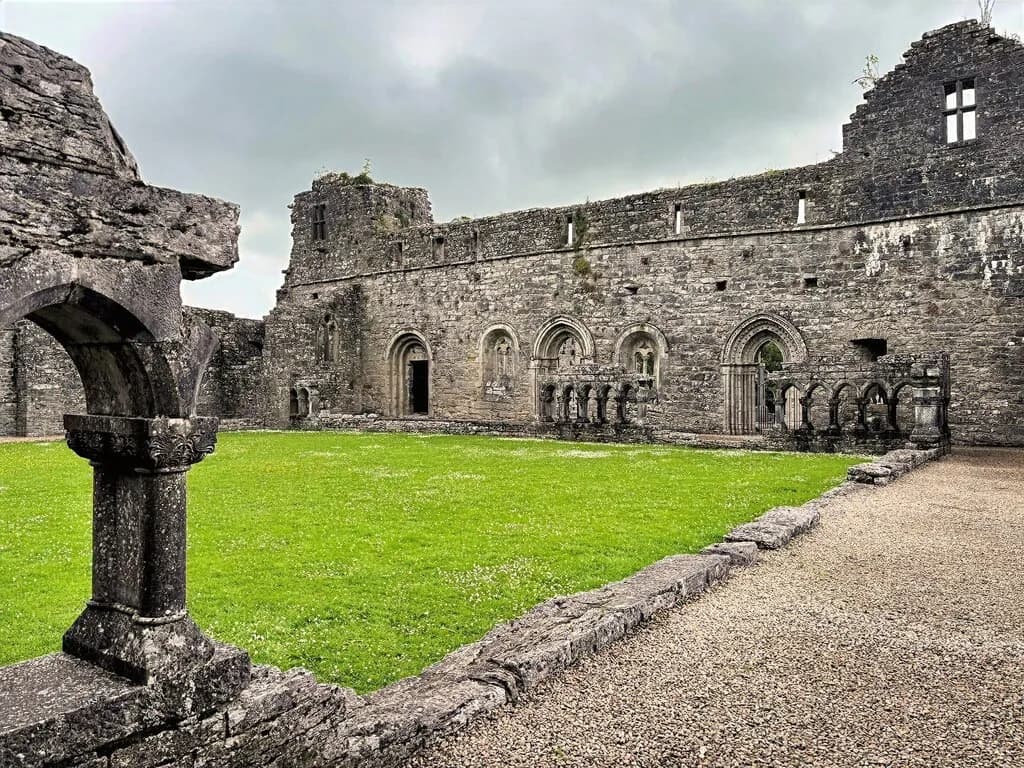
Saint Feichin founded a monastery on the isthmus in the seventh century. The Augustinian house whose ruins stand in the middle of the village today was founded in the twelfth century by Turlough O'Connor, King of Connacht, on the earlier site; the church is recorded as burning in 1114 and again in 1137. Rory O'Connor, the last High King of Ireland, is said to have spent his final years here. After the dissolution of the monasteries in the 1530s the property changed hands three times, passing to the Binghams, then the O'Donnells, then the Brownes. The Office of Public Works, which now holds it as a national monument, is careful about what is original: the north and south walls and the east gable of the church, and the north-east part of the cloister, with most of the rest being later reconstruction, much of it paid for by Benjamin Guinness in 1855. The abbey's most famous object is not here. The Cross of Cong, a processional cross of about 1123 made to hold a relic of the True Cross, is in the National Museum of Ireland in Dublin.
The Guinness century
Sir Benjamin Guinness bought the Ashford estate in 1852 from Lord Oranmore and Browne through the Encumbered Estates Court, and over the following decades he and his son Arthur, Lord Ardilaun, remade the landscape around Cong. They extended the estate to 26,000 acres, built roads, planted thousands of trees, added the Victorian and neo-Gothic wings that give the castle its present silhouette, and cut a private track network so the family could cross their own land without using public roads. Those tracks are now the village's off-road walking and cycling. Ardilaun subsidised steamers on Lough Corrib, including the Lady Eglinton, which connected the upper lake villages to Galway city, and took his title from Ardilaun, an island in the lough that formed part of the estate. The Cong Canal was his failure and the woods were his success: the redwoods and giant sequoia standing in Cong Wood are a Victorian planting, not a native one.
The summer of 1951
John Ford brought the cast and crew of The Quiet Man to the west of Ireland in the early summer of 1951, and they worked here until late August. The film was released on 14 September 1952 and won two Oscars, for Best Director and Best Cinematography. The distinction between those two years matters locally, because almost everything in Cong that references the film is dated by the shoot rather than the release: the local papers whose cuttings hang in the museum were printed in 1951, the costumes were made by O'Maille's of Galway for the 1951 unit, and Pat Cohan's Bar, which was a grocery shop when the crew painted a pub front on it, dates its own founding to 1952, the year after. What is genuinely here is the village exteriors: Innisfree is Cong. What is not here is the cottage. White O'Morn stood at Tiernakill South near Maam, which is roughly a half-hour drive west and in County Galway, and it is a ruin; the Quiet Man Bridge is at Leam near Oughterard, also Galway; and the cottage interior was a set in California. The replica on Circular Road is the only place the exterior and the interior exist together.
A village in two counties
Cong village is in County Mayo. Walk south for ten minutes and you are in County Galway. The boundary runs between the village and the Ashford estate, and it puts the castle, the golf course, Ireland's School of Falconry and the Ashford Equestrian Centre on the Galway side, along with Cong Wood across the river, while leaving Main Street, the abbey, the Monks' Fishing House, the Lodge at Ashford Castle and Lisloughrey Pier in Mayo. The castle's postal address is Cong, County Mayo, with a Mayo Eircode, and the State's own National Inventory of Architectural Heritage records the building under County Galway, entry 30402719. Both are correct: the address follows the post office and the ground follows the boundary. It carries on outward. The Pigeon Hole is in Galway. Inchagoill, where the afternoon lake cruise lands, is in Galway. Clonbur, at the far end of the forest walk, is in Galway. Even the bus that links Cong to its nearest railway station at Claremorris, a Mayo town, is operated by TFI Local Link Galway.
Trout, salmon and the mayfly
Cong has been the traditional base for fishing Lough Corrib and Lough Mask since the nineteenth century, and for a certain kind of visitor that is still the only reason to come. Both loughs are wild brown trout waters with international reputations; the brown trout season generally runs from February to September, and the mayfly hatch in May is the week the village fills with anglers rather than tourists. The Cong River and Lough Corrib also carry salmon, and there is a salmon hatchery in the village, which is why a large run returns here. Boats and gillies are hired locally rather than booked online, and salmon licences are sold in the village. None of this is visible from Main Street, which is part of the point.
Wildlife & Nature
Mammals
Pine marten
Cong Wood is one of the strongholds for pine marten in this corner of Connacht. Shy, mostly nocturnal and far more often detected by droppings on a forest track than seen.
Dusk, spring and early summer
Red squirrel
Red squirrels persist in the Guinness plantation here, helped by the same pine marten population that suppresses grey squirrels. Look in the conifer sections rather than the broadleaf.
Early morning, autumn
Otter
Otters work the Cong River below the abbey and the shoreline at Lisloughrey. The stretch by the Monks' Fishing House is as good a place as any to stand still for twenty minutes.
Dawn and dusk, year-round
Irish hare
On the open ground north of the village toward the canal and the Moytura stone circles rather than in the woods.
Early morning, spring
Birdlife
Mute swan
Resident on the Cong River and around Lisloughrey Pier, and the bird most visitors actually see.
Year-round
Grey heron
Standing in the shallows below the abbey, generally in the same three or four places.
Year-round
Common tern
Breeds on islands in Lough Corrib and is easiest to see from the lake cruise rather than from shore.
May to August
Flora
Giant sequoia and coast redwood
Victorian specimen trees planted during the Guinness ownership of Ashford, standing in what otherwise looks like ordinary Mayo woodland. They are the reason the Coillte nature trail is worth walking rather than just pleasant.
Year-round
The abbey yews
The clipped yew walk running out of the abbey cloister toward the river is the single most photographed piece of planting in the village and the thing that sets its colour.
Year-round, best in flat light
Limestone grassland plants
The thin soil over the isthmus limestone supports a calcium-loving flora on the open ground and along the canal banks, including orchids in early summer.
May to July