About Clifden
The history, geography, and character of Clifden.
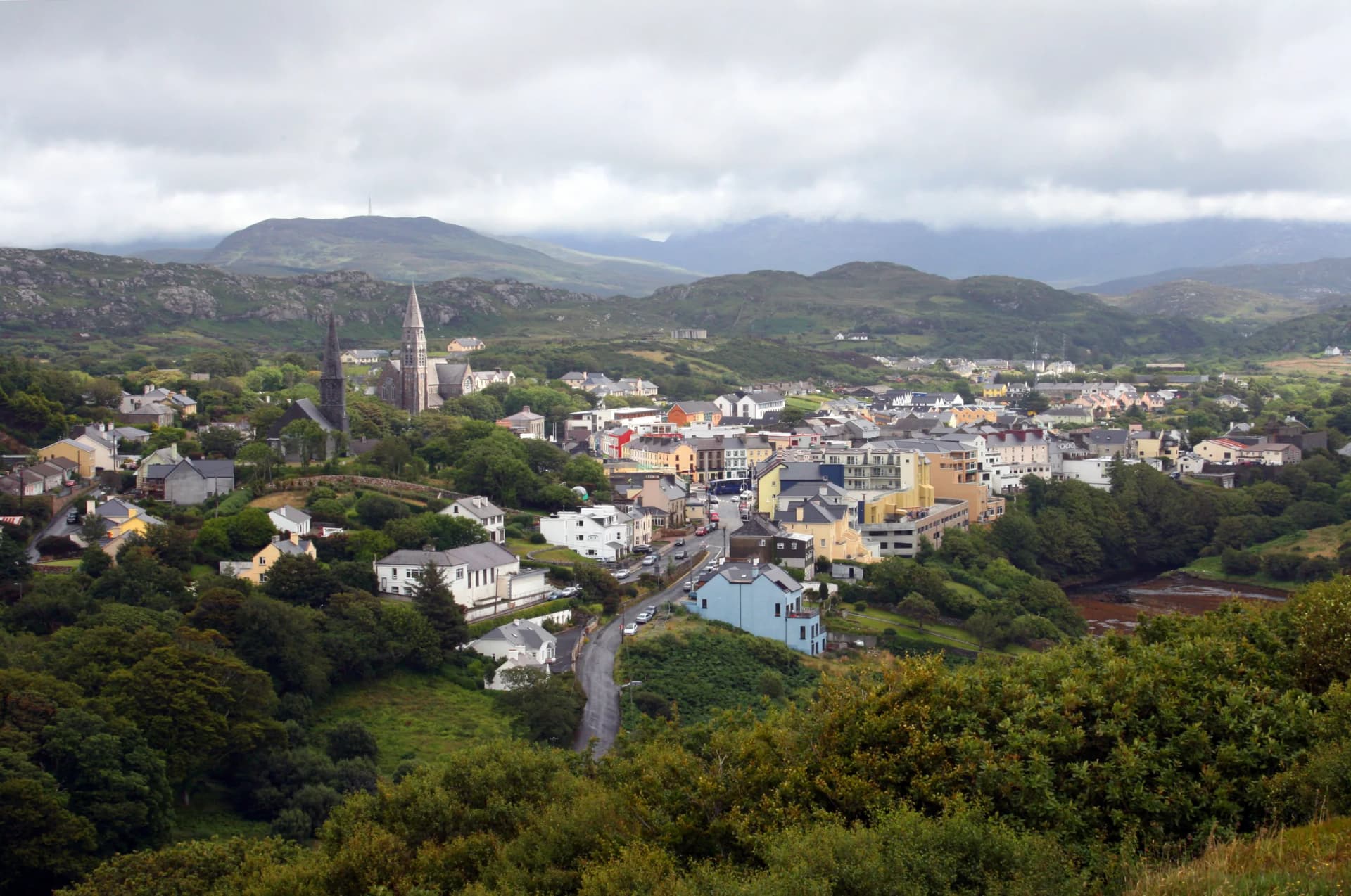
Clifden, in Irish An Clochán, is the largest town in Connemara and is widely called its capital, a place of under two thousand people on the Atlantic edge of Co. Galway. It was founded around 1812 by John D'Arcy, a member of one of the old Tribes of Galway, who set out to build a town on his Connemara estate. Its two church spires stand against the Twelve Bens, and it is the base from which most of west Connemara is explored: the Sky Road, the ruined D'Arcy castle, the Derrygimlagh bog and the tidal island of Omey.
History & Heritage
The town D'Arcy built
Clifden was the creation of one man. Around 1812 John D'Arcy, then in his twenties and the owner of a seventeen-thousand-acre estate, decided to build a town where there had been almost nothing, on the site associated with an old clochán, the beehive stone hut that gives the place its Irish name, An Clochán. He laid out a main street and a square, encouraged settlers, and built a quay. By the 1831 census the town held around 1,257 people in nearly 200 houses, with schools, churches and a brewery. D'Arcy died in 1839, and the Great Famine of the 1840s hit Connemara hard, but the town he founded survived and became the established centre of the region. His memory is marked by the D'Arcy Monument on the hill above the town, and the ruin of his Gothic Revival manor, Clifden Castle, still stands out the Sky Road. The two spires that define the skyline, the Catholic St Joseph's and the Protestant Christ Church, both date from the 19th century, and the Catholic church stands on the site of the ancient clochán itself.
The edge of the Gaeltacht
Clifden sits at the heart of Connemara, in Irish Conamara, a name that comes from Conmaicne Mara, an ancient people of the sea. Connemara holds most of the Connacht Gaeltacht, the largest Irish-speaking region in Ireland, and Irish is still an everyday language across much of the wider area, though Clifden town itself is largely English-speaking. The landscape is the draw: the quartzite peaks of the Twelve Bens, in Irish Na Beanna Beola, the open bog, the maze of inlets and islands along the coast, and the green Connemara marble quarried in the hills. The town is the practical base for all of it. From here you can drive the Sky Road, in Irish Bóthar na Spéire, the looped coastal road west of town; walk out to the ruined castle; cross to Omey Island at low tide; or head north to the Connemara National Park at Letterfrack and the famous walk up Diamond Hill. The roads are slow and the weather comes straight off the Atlantic, so Connemara rewards people who are willing to take their time.
Marconi, and the first flight across the Atlantic
A few kilometres south of Clifden, out on the open Derrygimlagh bog, two pieces of history sit on the same patch of ground. In 1907 Guglielmo Marconi opened the world's first commercial transatlantic wireless station here, a sprawling complex that sent messages across the ocean by Morse code and employed hundreds of local people. Its ruins still stand on the bog, condenser house, power station and the foundations of the masts. On 15 June 1919, the aviators John Alcock and Arthur Brown came down into the same bog at the end of the first non-stop transatlantic flight, having flown a Vickers Vimy from Newfoundland in under sixteen and a half hours. They mistook the soft bog for a green field and the plane nosed in, but both men walked away. A cairn marks the spot, and the looped Derrygimlagh trail, one of the Wild Atlantic Way's Signature Discovery Points, takes in both stories. It is an extraordinary thing, this much history on an empty Connemara bog, and it is one of the best reasons to come.
Ponies, festivals and the modern town
Clifden's calendar turns on two late-summer fixtures. The Connemara Pony Show, run by the Connemara Pony Breeders' Society at the Clifden Showgrounds since 1924, fills the town for a week in August with breeders and riders from around the world; it is the showcase of the hardy native Connemara pony and a genuine working event, not a tourist confection. A few weeks later, the Clifden Arts Festival, billed as Ireland's longest-running community arts festival, takes over the town for most of September with music, poetry and street performance. The rest of the year Clifden is a small Atlantic town getting on with itself, busy with visitors in summer and quiet in winter. There is no railway, the line to Galway closed in 1935, so the road in is the N59 across the bog, around eighty kilometres from Galway city. The pubs on Main Street and Market Street, Lowry's and E.J. King's among them, keep the trad music going, and the seafood restaurants make the most of what comes off the Connemara coast. It is a town that lets the landscape do the talking, and the landscape is some of the finest in Ireland.
Wildlife & Nature
Marine Life
Grey Seal
Grey seals haul out on the rocks around Clifden Bay and are a regular sight on the boat trips, especially at Seal's Rock.
Year-round
Common Dolphin
Common dolphins and the occasional whale are sometimes seen off the Sky Road and from Eyrephort Beach in the Atlantic swell.
Summer and autumn
Birdlife
Chough
The red-billed chough, a rare upland crow, breeds on the Connemara coast and is seen along the Sky Road cliffs.
Year-round
Connemara Pony (semi-wild)
The hardy native Connemara pony grazes the hills and commonage around Clifden and is celebrated at the August Pony Show.
Year-round
Flora
Bog heather and the open bog
The Derrygimlagh and Roundstone bogs turn purple with heather in late summer and gold in autumn, a hallmark of the Connemara landscape.
Late summer and autumn
Maerl at the coral strand
The pale 'coral' sand at Mannin Bay is maerl, a coralline algae, built up over centuries along the Connemara coast.
Year-round