About Bantry
The history, geography, and character of Bantry.
History & Heritage
The name and the bay
Bantry takes its English name from Beanntraí, the territory of the Beanntraighe, an early population group associated with the area. The town grew up at the head of Bantry Bay, a deep, wide natural harbour that runs some 30km inland from the open Atlantic between the Sheep's Head and Beara peninsulas. The bay's scale and depth have made it strategically and industrially significant for centuries: it sheltered naval fleets in the age of sail, and Whiddy Island, out in the bay, hosted a major oil terminal from the 1960s.
The French fleet and the Earls of Bantry
In December 1796, a French invasion fleet of more than forty ships, carrying troops intended to support Wolfe Tone's United Irishmen, anchored in Bantry Bay. The invasion never landed; unfavourable winds scattered the fleet before troops could get ashore. Richard White, the local landowner who organised the district's defences during the crisis, was created Baron Bantry in 1797 and later the 1st Earl of Bantry in 1816. His family had built Bantry House on the hill above the town in 1739, and the White family has lived there ever since, one of the few Irish stately homes never to have passed out of its founding family's hands. The house's formal gardens, laid out by the second Earl in a style inspired by continental palazzo gardens, and its well-known hundred stone steps, remain the town's best-known visitor draw.
Whiddy Island and the Air India memorial
Bantry Bay's history has not been all quiet harbour trade. In January 1979, the French oil tanker Betelgeuse exploded while unloading at the Whiddy Island oil terminal, killing 49 people and devastating the local economy for years afterward; the island still carries physical traces of the disaster. In June 1985, Air India Flight 182 crashed into the Atlantic off the southwest Irish coast, and Bantry area residents played a significant part in the recovery effort and in caring for victims' families, an act of compassion that is still remembered locally and marked by the Air India Memorial Garden at Ahakista on the Sheep's Head peninsula.
The market town today
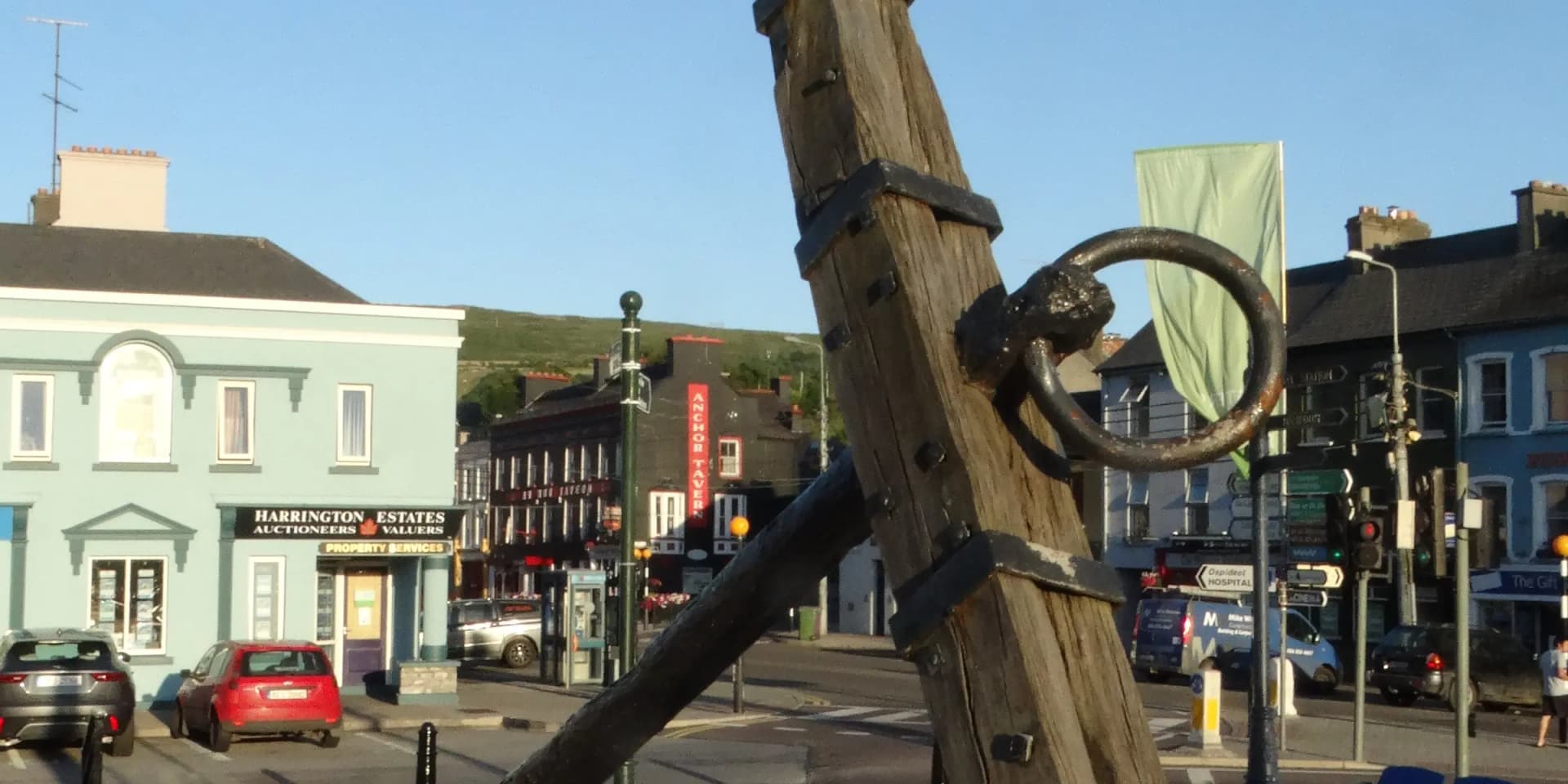
Bantry's population stood at 2,929 at the 2022 census, a genuinely small town relative to its role as a regional hub. The Friday market on Wolfe Tone Square, widely described as the biggest in County Cork, is the clearest sign of the town's continuing working character: farmers, fishmongers and craftspeople still fill the square every week rather than a curated tourist stall selection. Bantry also anchors two of west Cork's biggest cultural events, the West Cork Chamber Music Festival, centred on Bantry House each summer, and the West Cork Literary Festival straight after it, both of which draw visitors well beyond the town's own size.
The gateway role
Bantry sits at a genuine crossroads in west Cork. The Sheep's Head peninsula, quieter and less visited than its neighbours, runs southwest from the town and starts and finishes its 107km waymarked walking loop on Wolfe Tone Square itself. The road north leads to Glengarriff, the ferry crossing to Garnish Island's Italianate gardens, and on to the wilder Beara Peninsula and the Ring of Beara. Very few towns this size give a visitor all three directions, walking, gardens and mountain peninsula, from a single base, which is the practical reason Bantry works so well as somewhere to stay rather than simply drive through.