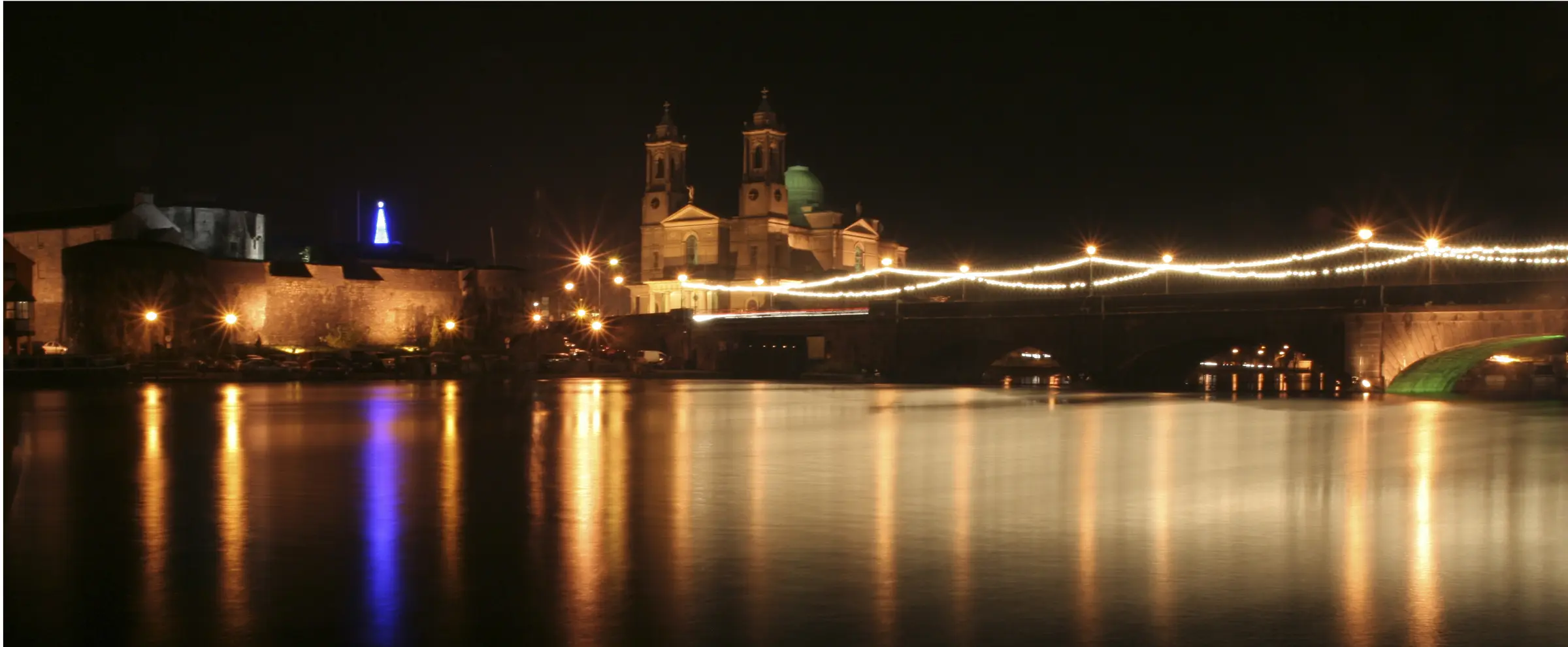
About Athlone
The history, geography, and character of Athlone.
Athlone is a midlands town split by the River Shannon at the point where it opens out into Lough Ree, with County Westmeath on the east bank and County Roscommon on the west. The crossing here is the reason the town exists: Baile Átha Luain, the town of Luan's ford, names a river crossing old enough that the pub now standing on the ford site, Sean's Bar, is dated by the National Museum of Ireland and Guinness World Records to around 900 AD. An Anglo-Norman castle has guarded that crossing since the 12th century, and the town grew up around it and around the ford, later becoming a garrison town, a railway junction, and, with the 2022 census counting 22,869 people, the midlands' second-biggest town after Mullingar. Today it is known for its Left Bank food and arts quarter, for Sean's Bar's genuine claim to be one of Europe's oldest pubs, and for its position as the recognised hub for cruising the Shannon and Lough Ree.
History & Heritage
A town split by the Shannon
Athlone straddles the River Shannon at the point where the river broadens into Lough Ree, the second-largest lake on the Shannon system. County Westmeath holds the east bank, with the modern town centre, Church Street and the Golden Island retail area; County Roscommon holds the west bank, the older Left Bank quarter around the castle. A bridge has crossed the river at this point since the town began, and locals still identify strongly with which bank they live on. The town's position, roughly in the centre of Ireland, made it a natural garrison and crossing point for centuries and later a railway junction, and it still functions as a genuine touring base for the midlands rather than a place travellers only pass through.
The castle and the 1691 siege
Athlone Castle began as a wooden fortress raised by the Connacht king Turlough O'Connor in the 12th century to guard the Shannon crossing, later rebuilt in stone by the Anglo-Normans. Its best-known moment came in 1691, during the Williamite War, when Jacobite defenders held the west bank against Williamite forces in the Siege of Athlone, a pivotal engagement on the road to the decisive Battle of Aughrim; accounts describe the defenders flinging their cannon into the river as they retreated. The castle's visitor centre and keep exhibition are, as of this research, closed to the public for a Fáilte Ireland-funded redevelopment that began in October 2025, with reopening pushed back from an original autumn 2026 target to spring 2027. The keep and the public realm around St Peter's Square remain part of the streetscape in the meantime, but the interior history displays are not currently accessible.
Sean's Bar and the Left Bank
On the west bank, a short walk from the castle, Sean's Bar occupies the site of Luan's original ford-side inn. Renovations in 1970 uncovered wattle-and-wicker walls dating to the 10th century, evidence the National Museum of Ireland and Guinness World Records both accept in dating the pub to around 900 AD, making it one of the oldest continuously operating pubs in Europe. The narrow streets around it, known locally as the Left Bank, form Athlone's cultural quarter: the Luan Gallery, County Westmeath's municipal art gallery, sits on Elliott Road a short walk away, and the quarter carries a food scene well beyond what a town this size usually manages, anchored by Thyme's Michelin Bib Gourmand kitchen and the long-running Left Bank Bistro overlooking the old lock.
The river, the lake and the arts
Athlone's identity beyond the Left Bank rests on the water and on a genuinely lively arts calendar. Viking Tours runs replica-longship cruises from beside the castle out onto Lough Ree and downstream to the early-medieval monastic site at Clonmacnoise, and the town is the recognised base for Shannon cruising holidays more broadly. On dry land, the 43 km Old Rail Trail Greenway follows the old Midlands Great Western Railway line out to Mullingar, linking the Shannon to the Royal Canal. Culturally, Athlone is the long-standing home of the RTÉ All-Ireland Drama Festival, an amateur-drama competition final hosted at the Dean Crowe Theatre most years since 1953, alongside the newer Croílár Music and Arts Festival each spring. The town's most famous native is the tenor John Count McCormack, one of the best-known singers of the early 20th century, commemorated with a statue in the town.
Wildlife & Nature
Birdlife
Lough Ree wintering waterbirds
Lough Ree, the stretch of the Shannon that opens out immediately north of Athlone, is a designated Special Protection Area (NPWS site code 004064) for its wetland and waterbird populations, spanning Counties Longford, Roscommon and Westmeath. Qualifying species include whooper swan, teal, mallard, tufted duck, goldeneye, wigeon, shoveler, common scoter and coot, along with golden plover and lapwing on the surrounding wetlands and common tern on the lake itself.
Autumn and winter for the wintering wildfowl (whooper swan, teal, wigeon, goldeneye); summer for breeding common terns