About Padstow
The history, geography, and character of Padstow.
History & Heritage
The harbour and the Doom Bar
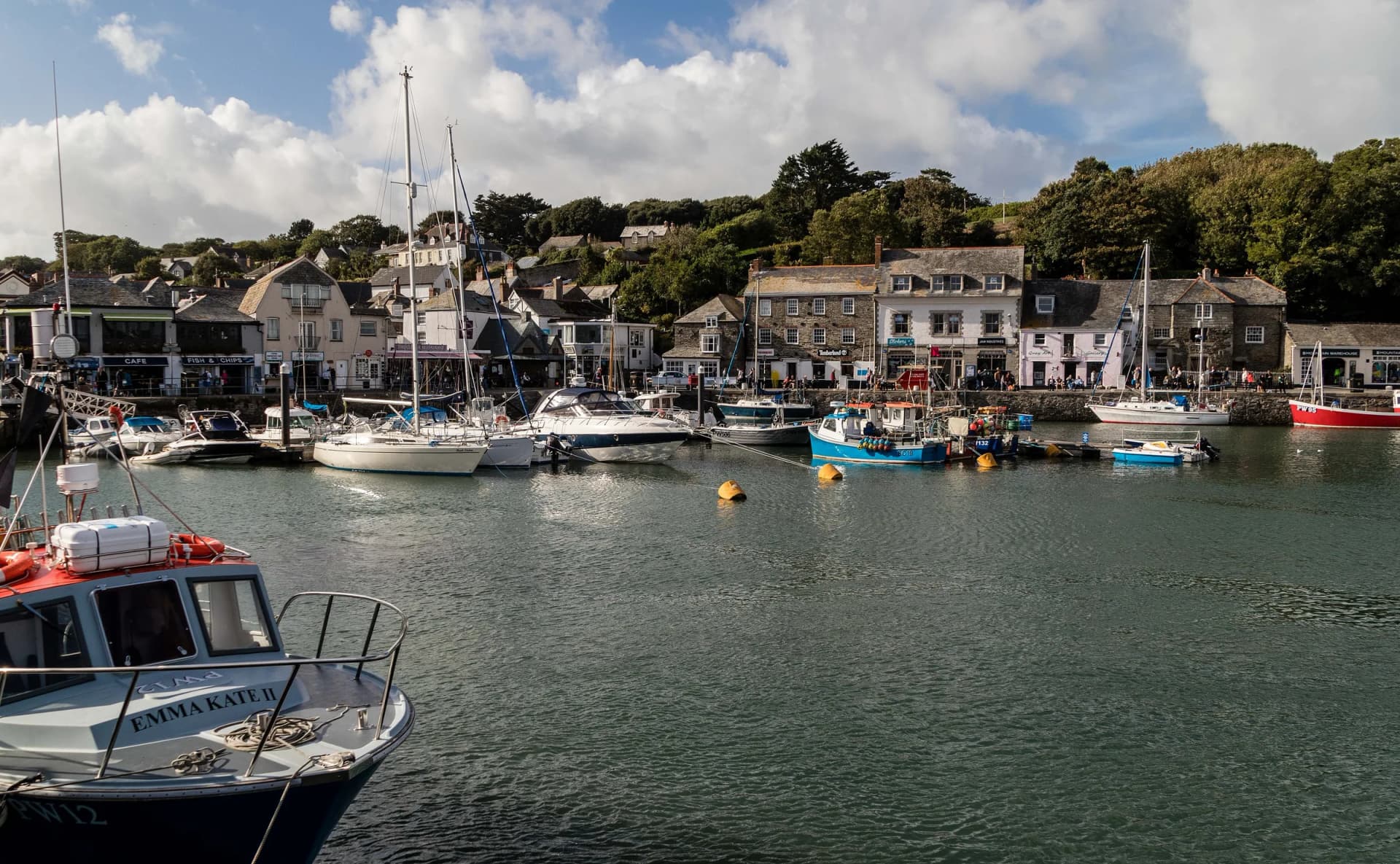
The Padstow Harbour Commissioners describe Padstow as a small commercial port, 1.5 miles from the sea within the estuary of the River Camel, with regular landings of fish, crab and lobsters and a growing shellfish farming industry in the estuary producing mussels, cockles, oysters and scallops. Leisure craft are now the main users. Getting in means crossing the Doom Bar, the sandbank at the river mouth, and the commissioners' own advice to visiting boats is to use their navigation video and passage plan for the safest entry. The inner harbour sits behind a floodgate; the commissioners say it takes vessels up to 9.5 metres across through a 10 metre opening. A traditional ballad, quoted on the South West Coast Path's route page, blames the sandbar on the Mermaid of Padstow, who threw it across the river after a local man shot her, mistaking her, so he said, for a seal.
St Petroc and the Prideaux family
The town's name is Petroc's place: the Welsh missionary St Petroc is said to have landed at Trebetherick, across the estuary, around AD 500, and a monastery was founded on the site. A place the Anglo-Saxon Chronicle calls Petroces stow, probably Padstow, was raided by Vikings in 981, and the monks are thought to have moved inland to Bodmin, taking Petroc's relics with them. The manor belonged to Bodmin monastery until the Prideaux family took a lease from the last prior before the dissolution of the monasteries. Prideaux Place, above the town, was completed in 1592, and the family says it has been home to the same family for fourteen generations.
The railway that became a trail
Padstow station, the western end of the North Cornwall Railway, opened on 27 March 1899 and closed to passengers on 30 January 1967. The Atlantic Coast Express ran here from London Waterloo, and the tourist office says John Betjeman called the line "the most beautiful train journey I know". Fish was the main freight, often reaching 1,000 wagonloads during a spring season. Today the track bed is the Camel Trail, Station House holds Padstow Museum, and the Railway Car Park keeps the name.
May Day
The first written mention of the 'Obby 'Oss at Padstow dates from 1803. Before the First World War there was one hobby horse, the Old 'Oss, whose stable is the Golden Lion. The Blue Ribbon 'Oss, also called the Peace 'Oss, was added at the end of that war, based on an earlier blue-ribbon horse; the museum says it had a red, white and blue ribbon round the rim of its gown and a beard on its mask. Each 1 May the two parties go round the town, with a teazer dancing in front of each 'Oss, and 20 or more accordion and drum players in each party. The museum's own account is that the custom is Padstow's, and not put on for the people who come to watch.
The Stein effect
Rick and Jill Stein opened The Seafood Restaurant in 1975. Rick Stein's own site lists five restaurants and bars, three shops, a cookery school and six places to stay in Padstow, and the nickname "Padstein" comes from that. A travel feature by Greg Dickinson, published on Yahoo News in August 2025, quoted a woman saying "it's not Padstein, it's Padstow", and the chair of the town museum praising what Stein had done for fishermen and staff. It also quoted a resident who moved here in the early 1980s saying that affordable housing is an issue and that the town is too busy in high summer.
A town of two and a half thousand
The parish had 2,669 people at the 2021 census, according to the Office for National Statistics figure summarised on Wikipedia; the town council says about 2,500, rising to about 5,500 in summer. It includes Trevone, on the open coast, as well as Padstow itself. Fishing is still part of the economy and tourism is the main industry, in the council's words. The Town Council's Cory toilets open only from Easter to mid-December, the Main Road car park only from Easter to the end of October, and the ferry's last boat moves from 5pm to 7.45pm through the year.
Wildlife & Nature
Marine Life
Seals and dolphins
Padstow Sealife Safaris lists grey seals, common dolphins, porpoises, sunfish and basking sharks as possible sightings on its trips out of the estuary, none of them guaranteed. The Jubilee Queen's operator lists common and grey seals sunbathing on the rocky shore.
Spring to autumn, weather and sea state permitting
The European lobster
The National Lobster Hatchery on the South Quay rears European lobsters and releases them into the sea, and its visitor centre lets you see hatchlings, berried females and large adults. It says it works with the fishing community on stock conservation.
Open every day, 10am to 4pm
Birdlife
Puffins
Padstow Sealife Safaris says puffins nest on an island its two-hour trip and its one-hour Puffin Safari visit, and can be seen from mid-April to mid-July.
Mid-April to mid-July, by boat
Estuary waders, little egrets and ospreys
The tourist office says the Camel estuary's salt marsh draws winter waders, that little egrets can be seen on the mudflats at low tide, that peregrines are common and that ospreys stop for a few days in spring and autumn. Shelduck, shoveller, teal and mallard live on the estuary.
Low tide for waders; winter for the salt marsh; spring and autumn for ospreys