About Inverness
The history, geography, and character of Inverness.
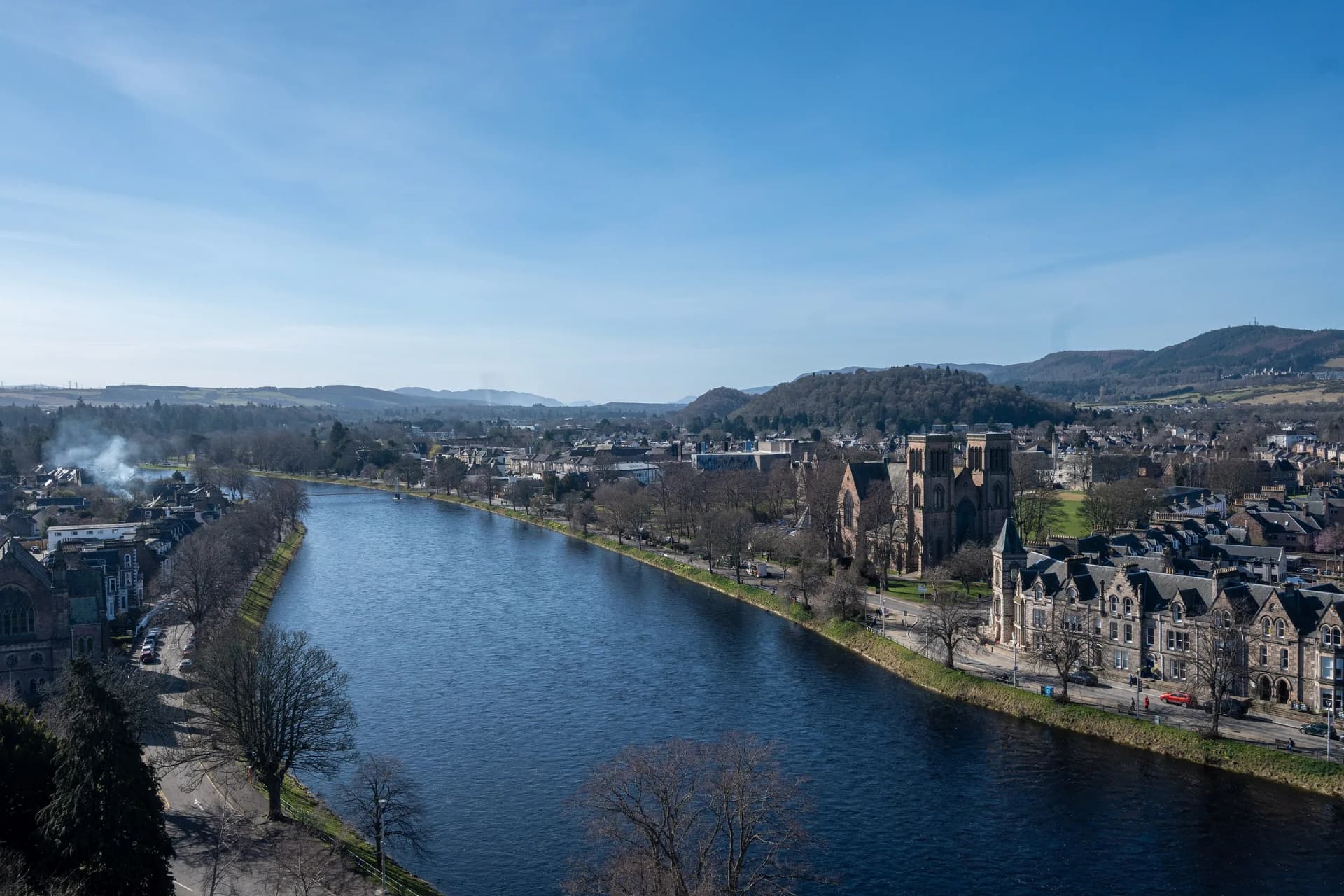
Inverness is the city at the mouth of the River Ness on the Moray Firth. Its Gaelic name, Inbhir Nis, says exactly that. Wikipedia gives its population as 47,790 in 2020, and it was made a city as a Millennium City. It is the place most people pass through on the way to Loch Ness, Skye or the north, which is a reason to stay a night rather than a reason to skip it.
History & Heritage
The name, and what locals call it
Inbhir Nis means the mouth of the River Ness. Wikipedia records two nicknames for the city, Inversnecky and the Sneck, and says that people born here are traditionally called Clann na Cloiche, the children of the stone. The city status grant is given as 2000 in the lead of that article and as 2001, when the letters patent were sealed, further down; both refer to the same Millennium City award.
A city laid out along a river
The Ness runs north through the middle of the city to the Moray Firth. The castle stands on its hill above the east bank; the cathedral and Eden Court, the city's main theatre, cinema and arts centre, face it from the west bank. Upstream, about a kilometre and a half from the Ness Bridge, the Ness Islands are two wooded islands joined by footbridges. The Caledonian Canal runs through the Great Glen, linking Loch Ness, Loch Oich and Loch Lochy, and across the firth the Kessock Bridge carries the road to the Black Isle.
The castle
Inverness Castle was built in 1835 on the site of a medieval predecessor, according to Wikipedia. After a £47 million redevelopment it reopened on 9 February 2026 as the Inverness Castle Experience, operated by High Life Highland for the Highland Council, which expects around 450,000 visitors a year, 200,000 of them to the paid exhibition. The gardens, the Saltire Bistro and the shop are free to enter.
Culloden
About five miles east of the city is Culloden Moor, where the final Jacobite Rising came to an end on 16 April 1746. The National Trust for Scotland runs the battlefield and visitor centre. A little over a kilometre from the visitor centre, as the crow flies, Historic Environment Scotland looks after Clava Cairns, a cemetery of cairns it dates to about 4,000 years ago.
The Victorian Market
The covered market between Academy Street and Union Street was first built in 1869 to 1870, gutted by fire on 23 June 1889 and reopened on 8 September 1891, according to Wikipedia; the Academy Street entrance is from the first building. It is Category B listed. The Highland Council refurbished its market and fish hall into a food hall, described in the council's news in June 2023.
Wildlife & Nature
Marine Life
Salmon in the Ness
The tourism body's Ness Islands listing says that in summer you can watch anglers catching salmon from the islands.
Summer