About Cambridge
The history, geography, and character of Cambridge.
History & Heritage
Highlights
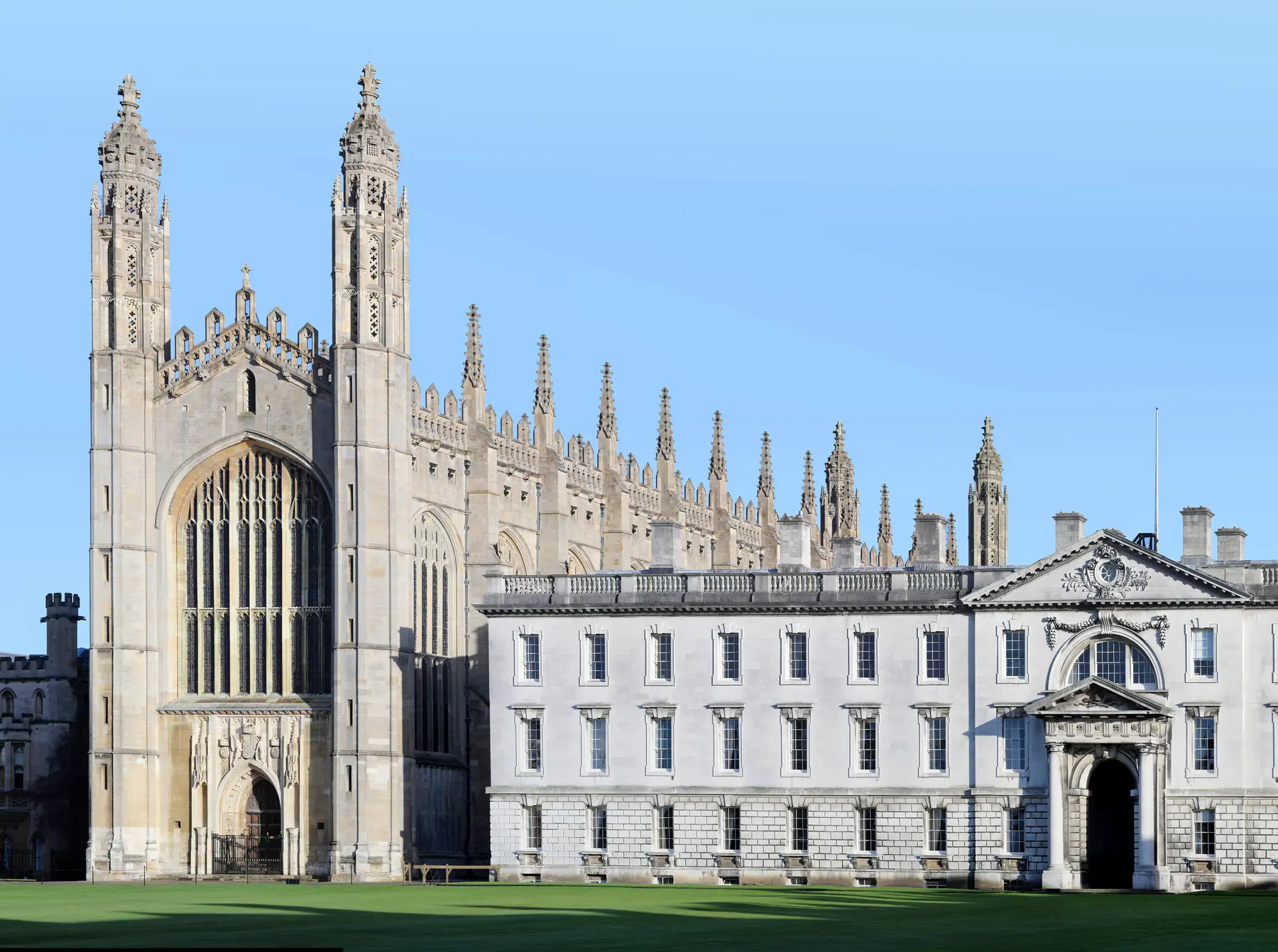
King's College Chapel, the late-Gothic fan-vaulted chapel begun by Henry VI in 1446 and finished under the Tudors, whose choir sings evensong most days of term and whose Christmas Eve Festival of Nine Lessons and Carols has been broadcast by the BBC since 1928; punting on the Cam past the Backs, either self-punted or chauffeured from the Mill Lane or Silver Street stations; the free Fitzwilliam Museum, one of Britain's best university art collections, from Egyptian antiquities to Titian and Turner; Kettle's Yard, the quietly hung modernist house-turned-gallery near Magdalene Bridge; the Cambridge University Botanic Garden's 40 acres near the station; the historic Market Square, still trading daily; and the annual rhythm of Cambridge Beer Festival on Jesus Green, the Cambridge Folk Festival at Cherry Hinton Hall, and June's May Week, when the colleges hold their formal balls after exam term ends.
The colleges and the Backs
Cambridge's 31 colleges are independent, self-governing institutions that admit their own students, own their own land and buildings, and set their own visiting hours; there is no single 'university campus' to visit, only a scattered federation of walled courts. Several open their courts and chapels to visitors for a fee or by donation (King's, Trinity, St John's, Clare and Queens' among the most visited); others stay closed to the public most of the year. The Backs, the shared name for the college gardens and lawns running along the western bank of the Cam from Magdalene Bridge down past St John's, Trinity, Clare, King's and Queens', is the one view that ties the whole city together, and the only way to see it properly is from the water: on a punt, poled from the flat riverbed rather than rowed, the method Cambridge settled on because the Cam here has no current worth fighting.
Town and gown
The relationship between the university (gown) and the working city around it (town) has shaped Cambridge for eight centuries, from the 1381 Peasants' Revolt attacks on university property to the ordinary friction of a small city whose centre is dominated by an institution most residents do not belong to. It shows up today in small, real ways: Mill Road, east of the railway station, is the city's more mixed, less collegiate high street, home to independent shops, a large South Asian and Portuguese community, and restaurants that have nothing to do with the tourist trail; the Grafton Centre and the Beehive Centre serve the ordinary weekly shop; and outside May Week and the summer peak, most of Cambridge goes about a fairly unremarkable English market-town life around the edges of the postcard centre.
Beyond the centre
Grantchester, the village upstream of Cambridge reached by punt or by the riverside footpath across Grantchester Meadows, is the classic half-day extension: Rupert Brooke lived there before the First World War and wrote about its clock stopped at ten to three, Virginia Woolf and the Bloomsbury circle visited, and the Orchard Tea Garden has served tea under the fruit trees since 1897. Midsummer Common and Jesus Green, the two big open commons on the north side of the river, host the city's Beer Festival and much of its outdoor summer life; Coe Fen and Lammas Land, south of the centre, are quieter green space closer to the station. None of it requires a car: Cambridge's compact, cycle-friendly core means most of what matters is within a twenty-minute walk or a ten-minute ride of the Market Square.
Wildlife & Nature
Birdlife
Swans, moorhens and herons along the Cam
Mute swans are a fixture of the river through the city centre and the Backs, alongside moorhens, mallards and the occasional grey heron working the quieter stretches near Grantchester Meadows; kingfishers are reported on the upstream reaches towards Grantchester by patient early risers.
Early morning, year-round, quietest upstream of the punt stations towards Grantchester
Flora
The avenue trees and lawns of the Backs
The Backs are as much a designed landscape as the colleges themselves: mature planes, limes and willows along the river frame the views of King's, Clare and Trinity, and the college gardens (Clare's in particular) are planted for continuous colour through the growing season.
Spring blossom in April and May, full leaf and garden colour through summer
Cambridge University Botanic Garden's collections
Forty acres near the railway station holding a systematic beds collection, a winter garden, a glasshouse range and a rock garden with a limestone ravine; the autumn colour and the winter garden's scented shrubs are both deliberately planted to give the garden a year-round reason to visit.
Spring bulbs in March and April, autumn colour in October, the winter garden from December to February