Two forts and a square: Caernarfon on foot
Y Maes, Edward I's castle, the walls you walk round rather than along, the Roman fort that gave Caernarfon its name, and where to eat on the way.
Caernarfon is a town with two forts in it, a thousand years apart, and a square between them where everybody ends up. Y Maes, Castle Square on the English signs, runs down to the castle, and from a table outside Caffi Maes at number 4 you can watch the whole town cross it. Start there, because everything on this walk is within a few minutes of it.
The castle, and what UNESCO actually listed
Edward I's castle went up after his conquest of north Wales, and Cadw, which runs it, says he and his military architect, Master James of St George, built the castle, the town walls and a quay all at once, a project that took 47 years. You will read that Caernarfon Castle is a World Heritage Site, and that is a slight upgrade. In 1986 UNESCO inscribed one property, the Castles and Town Walls of King Edward in Gwynedd, in four parts: Beaumaris, Harlech, and the castles with their town walls at Conwy and Caernarfon. Caernarfon's part is the castle and the walls together, which is worth knowing, because the walls are the part people skip.
Cadw's hours move with the season: 9:30 to 5pm from March to June, 9:30 to 6pm in July and August, 9:30 to 5pm in September and October, and 10 to 4 from November to February, last admission half an hour before closing, shut on 24, 25 and 26 December and 1 January. Cadw also warns it may close at short notice in extreme weather, and on a wet westerly on the Menai Strait that is not a theoretical line. An adult ticket is £14.90 from September 2026 to March 2027, a family of two adults and three children £47.70, and booking online takes 5 per cent off. The Royal Welch Fusiliers Museum is in two of the towers and comes with the ticket. If you have seen a line on Cadw's page about opening only Friday to Sunday from September, read it again: it is about the pop-up cafe, not the castle.
The walls you go round, not along
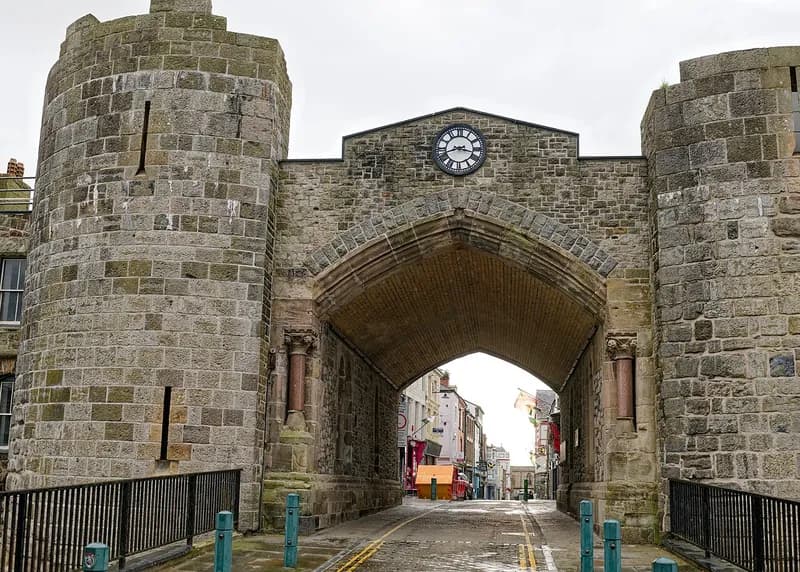
If you have come from Conwy, reset your expectations. At Conwy you walk the top of the wall. Here Cadw says the walls can be viewed externally only and that, for safety reasons, access onto them is not currently possible. They are free and open in daylight all year, which in practice means a walk through the streets and along the harbour, looking up. Cadw counts eight towers and two gateways on a circuit of almost half a mile, almost complete.
From the Maes, go down past the Palace Vaults on the corner of Castle Ditch, which locals call Pen Deitsh, head of the ditch. Out on the harbour the Anglesey stands against the outer face of the west wall; Cadw's record says it was the Customs House, said to date from 1736, and a hotel by 1852. Follow the promenade to Porth yr Aur, the West Gate, which Cadw says could only be reached from the sea in the 13th century, and on past the church at the north-west corner and along Bank Quay. Come back in to Northgate Street, which the Black Boy Inn says was once Stryd Pedwar a Chwech, Four and Six Street, after the price of a night in the old red-light days. At the top of the High Street is Porth Mawr, the East Gate, and on Tuesdays, Thursdays and Saturdays until the end of October 2026 you can borrow the key to its tower from Siop Lwsi on Pepper Lane, between 10 and 3. Finish down Hole in the Wall Street, Cadw's own pick for the feel of the old town. The whole loop is under a kilometre.
The Romans got here first
The fort that gave the town its name is not the castle. Caer is Welsh for fort, and the Romans had one here: Cadw says Agricola founded Segontium in AD 77 for a thousand auxiliary infantry, and that coins show they stayed until about AD 394, longer than at any other fort in Wales. Welsh legend later knew it as Caer aber Seint, the fort at the mouth of the Saint, in The Dream of Macsen Wledig, the same story Cadw says the castle's towers were built to recall. It is about 700 metres up from the Maes on Constantine Road, and what is there is the laid-out foundations in open grass.
Ring before you walk up. Cadw's page lists Segontium as free and open all year, and the same page carries a notice that it opens on selected dates as part of a guided tours programme from May to August, with tours at £12. Until Cadw squares those two, its number, 03000 252239, is the way to know.
Eating along the way
The Black Boy is walk-in only and runs a waiting list from the door; food is noon to 9pm, 9:30 at weekends, and it gets busier as the evening goes on, so put your name down early. Caffi Maes is the seat on the square, with Bar Bach, which calls itself the smallest pub in Wales, next door. The one table you book weeks ahead is the Gunroom at Plas Dinas, a country house 3.4km south at Bontnewydd, which says it has been in the Michelin Guide since 2022; that one needs a car or a taxi.
Before you go
Nothing on this walk needs a ticket except the castle. If the weather turns, the Palace Vaults is the nearest door to the castle gate.
Keep Reading
The Welsh Highland Railway from Caernarfon
Which steam train to take from the station under the castle, what it costs, how long it takes, and how to fit the castle in the same day.
History & CultureWelsh in Caernarfon: Cofis, Pen Deitsh and the names on the signs
What Cofi means, why the Palace Vaults is Pen Deitsh, what the bilingual street names say, and a few Welsh words worth having.
Planning a trip?
Explore restaurants, activities, accommodation, and more.