About Bristol
The history, geography, and character of Bristol.
History & Heritage
Highlights
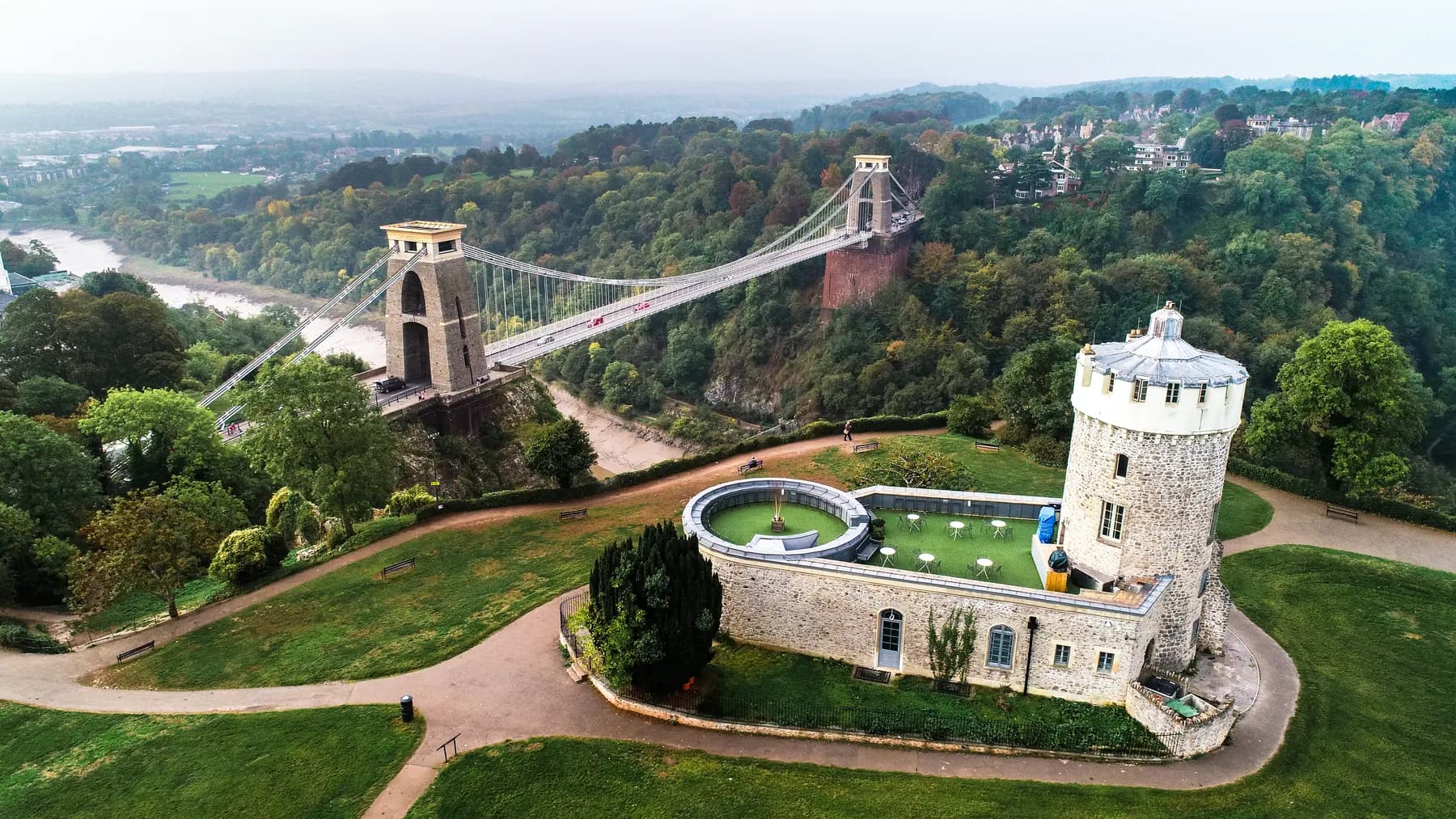
The Clifton Suspension Bridge, Brunel's 75-metre span across the Avon Gorge, free to cross on foot or by bike; Brunel's ss Great Britain, restored and afloat in the dry dock where she was built; the Harbourside itself, with M Shed's free social history museum and the preserved dockside cranes; the Banksy street art trail through Stokes Croft and the city centre, including the Mild Mild West on Cheltenham Road; St Nicholas Market's covered lanes of independent traders and street food, open since 1743; Clifton Village's Georgian terraces and independent shops; and Bristol Cathedral, an unusual medieval hall church a short walk from the centre.
Brunel and the bridge
Isambard Kingdom Brunel was twenty-four when his design won the competition to bridge the Avon Gorge in 1831, and the project outlived him: money ran out repeatedly, work stopped for years at a time, and the bridge that finally opened in 1864, five years after Brunel's death, was completed by other engineers using chains salvaged from one of his other projects, the old Hungerford Bridge in London. It remains a working road bridge today, carrying around four million vehicle crossings a year, and it is toll-free for anyone on foot or a bike; only motor vehicles pay. The free visitor centre on the Leigh Woods side tells the building story properly, including the near-disasters and the money troubles that make the finished bridge feel less inevitable than it looks from below.
The Harbourside
Bristol's Floating Harbour is not a preserved relic; it is a genuinely reused industrial space. The lock system that keeps the water level constant regardless of the Avon's huge tidal range, one of the largest in the world, dates to 1809 and is still in daily operation. Around it, M Shed occupies a real 1950s transit shed and tells Bristol's story through the people who worked the docks, including the city's role in the transatlantic slave trade and its abolition. The ss Great Britain sits in the same graving dock where she was built, with a glass sea at the waterline that lets visitors walk the underside of the hull as if she were still afloat. Wapping Wharf, a newer addition of restaurants and independent shops in shipping containers and old sheds, sits between the two, and cross-harbour ferries still run on demand for the price of a bus fare.
Banksy and Stokes Croft
Banksy grew up in Bristol and cut his teeth on its walls in the 1990s, and the city has never quite settled on how to treat what he left behind. The Mild Mild West, a teddy bear lobbing a Molotov cocktail at riot police, has watched over Stokes Croft's Cheltenham Road since 1999 and survives as one of the most durable and most photographed. Other pieces have been removed, sold, painted over, or in the case of the Grim Reaper, taken indoors entirely: it now lives at M Shed rather than on the side of the Thekla nightclub boat where it was painted. Stokes Croft beyond Banksy is a working street art district in its own right, a self-declared cultural quarter of independent shops, bars and murals that changes month to month, which makes a self-guided walk here a genuinely different experience each time.
Beyond the harbour
Clifton, up the hill past the bridge, is Bristol's other face: Georgian terraces and squares, independent shops along the Mall and Regent Street, and the Coronation Tap, Bristol's oldest cider house, tucked into a lane by the bridge itself. St Nicholas Market, in the old city near the harbour, has traded since 1743 and still runs a genuine mix of independent stalls, street food and a monthly night market rather than a curated tourist version of one. Bristol's seven hills mean a short walk from any of these areas involves a real climb, and locals navigate the city as much by which hill as by which street; Kingsdown, Montpelier and Totterdown all have their own identities within a few minutes of the centre, and most of them see far fewer visitors than the Harbourside and Clifton.
Wildlife & Nature
Birdlife
Peregrine falcons on the Avon Gorge
A pair of peregrine falcons has nested on the cliffs of the Avon Gorge near the Suspension Bridge in recent years, hunting pigeons over the gorge and the harbour; the Avon Gorge and Downs Wildlife Project has run public viewing points with telescopes on the Downs during the spring nesting season in past years.
Spring, when nesting; check the Avon Gorge and Downs Wildlife Project for current viewing point dates
Swans, gulls and waterbirds on the Floating Harbour
Mute swans, herring gulls and cormorants are a constant presence on the Floating Harbour itself, working the water around the moored boats and the ss Great Britain's dry dock.
Year-round, along any stretch of the Harbourside
Flora
Rare limestone flora of the Avon Gorge
The Avon Gorge's limestone cliffs support several plants found almost nowhere else in Britain, including Bristol rock-cress and Bristol whitebeam, both effectively unique to this gorge; the Avon Gorge and Downs Wildlife Project manages the site specifically for them.
Spring and early summer along the gorge-side paths and Downs