About Westport
The history, geography, and character of Westport.
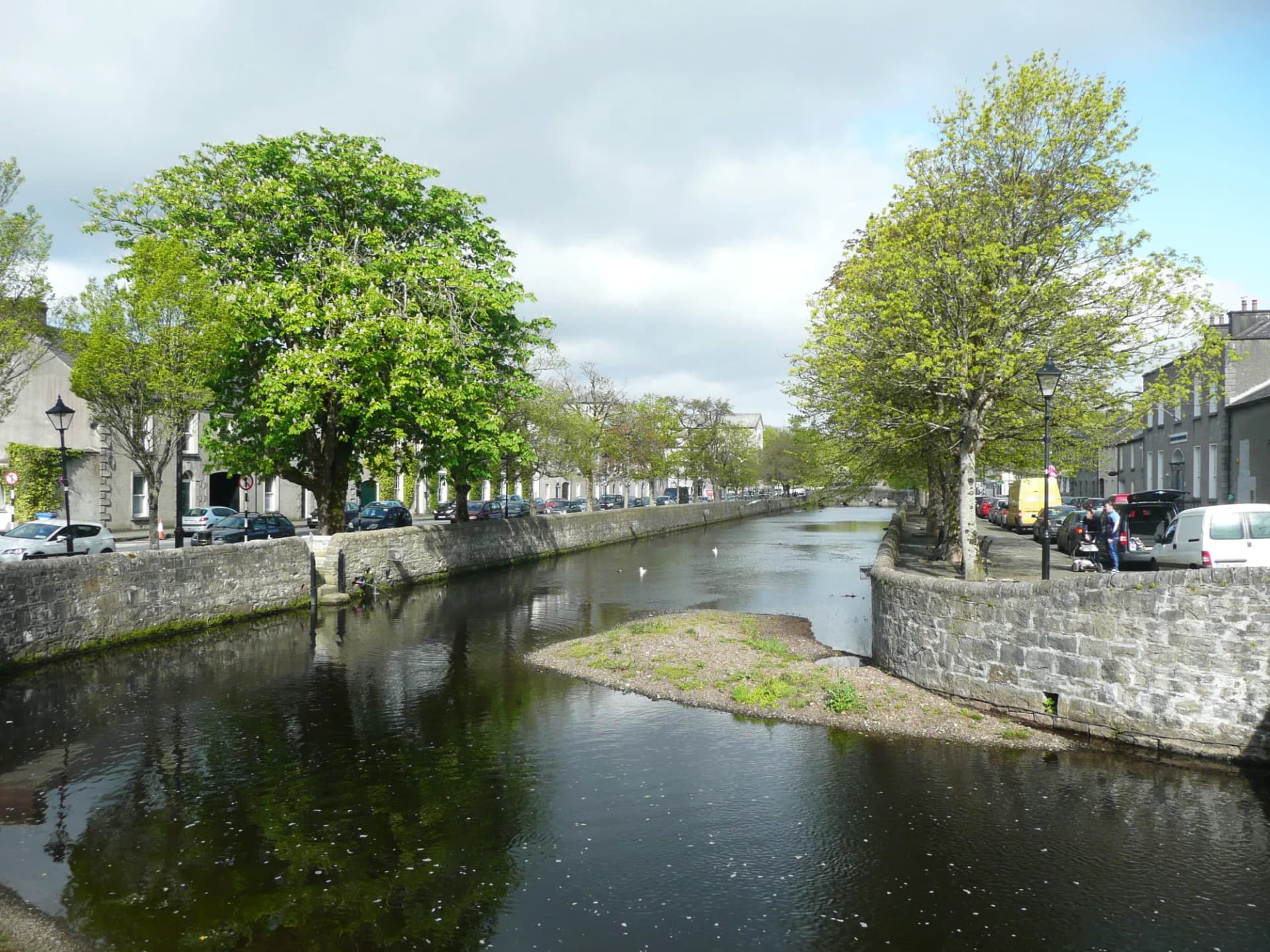
Westport is the tourism and culture capital of County Mayo, a planned Georgian town of around six thousand people set at the head of Clew Bay on the Wild Atlantic Way. It is one of the few towns in Ireland that was designed rather than grown, laid out for the Browne family beside their estate in the late 18th century, with the Carrowbeg river running canalised down the middle of a tree-lined Mall and the Octagon at its centre. Over it all stands Croagh Patrick, the holy mountain locals simply call the Reek.
History & Heritage
A town drawn on paper
Westport is one of a handful of fully planned towns in Ireland. From around 1767 the Browne family, later Marquesses of Sligo, laid out a new estate town beside Westport House, and the first clear record of it is an advertisement in Faulkner's Dublin Journal in March 1767 announcing that a new town was to be built. The Octagon, the eight-sided plaza where three streets meet, was probably laid out around then. The design is popularly credited to the celebrated English architect James Wyatt, who was working on completing Westport House in the 1780s, though careful sources attribute the actual street plan and the Market House largely to the local architect William Leeson. The tree-lined North and South Malls were built in the 1820s, when the Carrowbeg river was canalised between them and crossed by arched stone bridges, partly to dignify the approach to Westport House. The Octagon's column was raised in the 1840s for a local banker, George Glendenning; his statue was decapitated by Free State troops during the Civil War, and a statue of Saint Patrick in Portland stone was placed on top in 1990.
Westport House and the pirate queen
Westport House was built by the Browne family, who are direct descendants of Grace O'Malley, the 16th-century pirate queen of Connacht known in Irish as Granuaile. The line runs through the marriage of Colonel John Browne to Maude Burke, one of Grace O'Malley's great-great-granddaughters, and the house stands on the foundations of one of the pirate queen's castles. Part of that original castle survives in the basement and is shown to visitors today as the Dungeons. The house took shape across the 18th century under architects including the German Richard Cassels, who built the east front around 1730, and later James Wyatt and Thomas Ivory, with the square completed by the 1st Marquess of Sligo in the 1780s. The title and the house separated in 2014 after the death of the 11th Marquess, and in 2017 the local Hughes family, owners of the workwear firm Portwest and Hotel Westport, bought the house and its roughly 400-acre estate. It now trades as Westport Estate, with guided house tours, woodland walks, the cascade on the Carrowbeg and a large outdoor adventure park.
The Reek and the bay of islands
Croagh Patrick rises to 764 metres above the village of Murrisk, a few kilometres west of Westport, its quartzite cone unmistakable across Clew Bay. Saint Patrick is said to have fasted forty days on the summit, but the pilgrimage on the mountain predates Christianity, and folklorists have linked it to the harvest festival of Lughnasa. On Reek Sunday, the last Sunday in July, up to twenty-five thousand people climb it in a single day, some of them barefoot. Below the mountain, Clew Bay is famously said to have 365 islands, one for every day of the year, though the real count of these drowned drumlins, glacial hills now half-submerged, is closer to 120. It is the best example of a drumlin-field coast in Ireland. John Lennon bought the tiny island of Dorinish here in 1967 as a planned hideaway, and later let a hippie commune live on it for a couple of years. The Great Western Greenway, Ireland's first greenway, runs out along the bay on the line of the old Westport to Achill railway, which closed in 1937.
Music, MacBride and the modern town
For its size, Westport has an outsized reputation for traditional music, centred on Bridge Street. Matt Molloy, the flautist of the Chieftains, has owned a pub there since 1989, established on the site of an 1896 bar, and the back room hosts sessions most nights of the week; the 1993 live album Music at Matt Molloy's is one of the best-known Irish session recordings. The Porter House and other pubs keep the music going, and the Folk and Bluegrass Festival each June draws players from across Europe and America. The town has produced its share of history too. Major John MacBride, the 1916 leader executed at Kilmainham and once married to Maud Gonne, was born at the Quay in a building that is now the Helm bar and restaurant; a bronze bust of him stands on the South Mall. In modern times Westport has worn its looks well, winning the Tidy Towns competition three times and being named the Irish Times Best Place to Live in Ireland in 2012. It remains a genuine working town as well as a polished one, the base from which most of Mayo's west is explored.
Wildlife & Nature
Marine Life
Grey Seal
Grey seals haul out on the islands of Clew Bay and are a regular sight on the bay boat trips.
Year-round
Native Oysters
Native flat oysters and Pacific oysters are farmed in the clean water of Clew Bay off Kilmeena.
Autumn and winter
Birdlife
Brent Goose
Pale-bellied Brent geese winter on the mudflats and shores of Clew Bay.
Autumn and winter
Oystercatcher
Black-and-white waders with bright orange bills, common along the shore at Bertra and the Quay.
Year-round
Flora
Atlantic oak woodland at Brackloon
Brackloon Wood is a remnant of native Atlantic oak woodland, one of the last ancient oakwoods in the country.
Spring and summer
lime trees on the Mall
The avenues of mature lime trees along the North and South Malls are a hallmark of the planned town.
Spring and summer for full leaf