About Slane
The history, geography, and character of Slane.
Slane, Baile Shláine, is a village in east County Meath where the N2 from Dublin crosses the River Boyne. It is an estate village in the plain sense: the Conyngham family bought the estate in 1703 and rebuilt both the castle and the village in the eighteenth century, so the centre is a Georgian crossroads with four corner houses on the Square, and the castle stands behind its walls to the west. It is known well beyond its size for two things a short distance from the Square, the concerts in the castle grounds and the passage tombs of Brú na Bóinne downstream, but the village also has its own Hill, its own poet and its own whiskey.
History & Heritage
The Hill and the Flemings
Long before the castle, Slane's centre of gravity was the Hill to the north. Tradition makes it the place where St Patrick lit his Easter fire in defiance of the High King at Tara, and a monastery is said to have been founded there by St Erc, one of Patrick's followers. That is legend. What you can see is later: the Flemings, barons of Slane from the Norman period to the seventeenth century, built a motte on the western side of the hill in the twelfth century, and in 1512 they founded the Franciscan friary whose tower still stands, with a college beside it for four priests, four lay brothers and four choristers. Henry VIII dissolved it about thirty years later. The Flemings restored it in 1631 for Capuchin friars, who were driven out by Cromwell's forces in 1651. The Flemings lost their lands in the Williamite confiscations after the Boyne.
The Conyngham village
The Conynghams, a Scottish family settled in Donegal since 1611, bought Slane in 1703. The castle in its present form dates from a rebuilding begun in 1785 under William Burton Conyngham and his nephew, the first Marquess Conyngham, to designs by James Gandon, James Wyatt and Francis Johnston, with the parkland laid out by Capability Brown. Johnston's dramatic Gothic gates stand on the Mill Hill. The village around the crossroads was remodelled in the same century as a planned estate village. Its most-told story is about Lady Elizabeth Conyngham, said to have been the last mistress of George IV, and the claim that the king had the road from Dublin straightened to reach Slane faster. The castle's Gothic Revival ballroom was made for his state visit in 1821.
The mill and the river
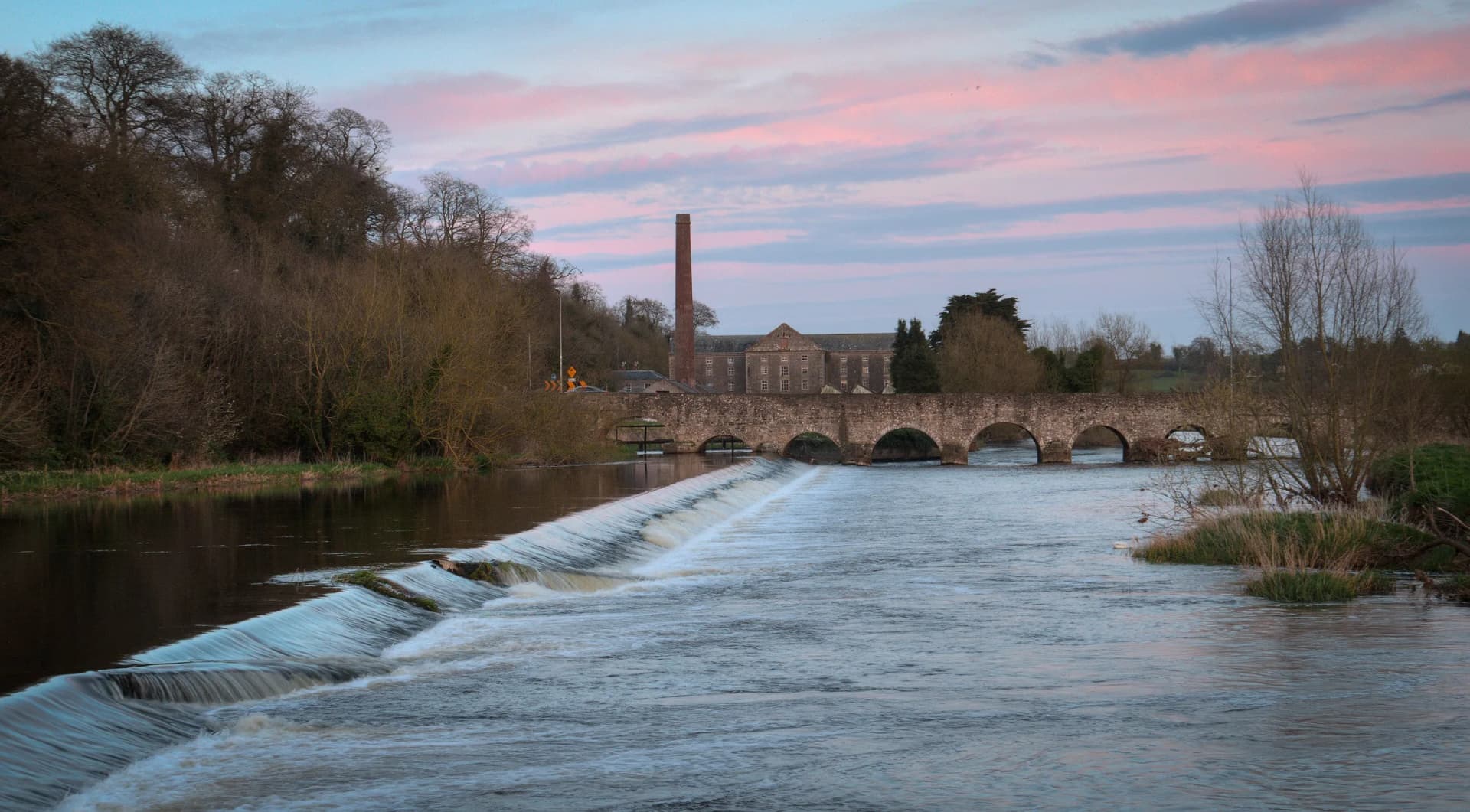
At the bottom of Mill Hill, Slane Bridge carries the N2 over the Boyne on a long run of stone arches, and just downstream stands Slane Mill, a mid-eighteenth-century corn mill notable for carved stonework more usual on a country house than a factory. A weir across the river feeds its mill race. Alongside the river runs the Boyne Navigation, the old canal and towpath between Navan and Drogheda, with locks above and below the village. The towpath upstream toward Navan is a published walk with interpretive panels; Meath County Council's proposed Boyne Greenway from Navan to Oldbridge would follow much of the towpath past Slane, but it is still in planning.
The concerts
In 1981 Thin Lizzy headlined the first open-air concert in the natural amphitheatre below the castle, with U2 in support, and Slane became an internationally known concert site, with a capacity the castle gives as 80,000. The Rolling Stones, Bob Dylan, Bruce Springsteen, David Bowie, Queen, R.E.M. and Guns N' Roses have all played it, and U2 lived in the castle in 1984 while recording The Unforgettable Fire. In 1991 a fire destroyed a third of the building and badly damaged the rest; the restoration took a decade. Concerts are not held every year: the castle's calendar lists Fontaines D.C. on 26 and 27 June 2027 and Oasis on 4 and 5 September 2027, both subject to licence.
Francis Ledwidge
Slane's poet was born on 19 August 1887 in a labourer's cottage at Janeville, just east of the village on the Drogheda road, the eighth of nine children. He worked as a road labourer and had poems in the Drogheda Independent from the age of fourteen, and in 1912 he wrote to Lord Dunsany, who became his patron and introduced him to Dublin literary circles. He enlisted in 1914, published Songs of the Fields in 1915 while serving, and was killed at the third battle of Ypres on 31 July 1917. He is remembered as the poet of the blackbird. The cottage has been a museum since 1982.
Wildlife & Nature
Mammals
Otter
The Boyne is a Special Area of Conservation, and otters live along it; they are shy and most often seen early in the morning or late in the afternoon.
Dawn and dusk
Birdlife
Kingfisher
Seen along the Boyne and the old canal on the towpath walks either side of Slane, usually as a flash of blue and orange low over the water.
Year round; early morning on quiet stretches of towpath
Grey heron
Stands for long spells at the water's edge on the Boyne and in the canal, hunting fish.
Year round
Flora
Littlewood's broadleaf trees
Oak, ash and alder with beech, horse chestnut and sycamore, over an understorey of hazel, rowan, holly, hawthorn and blackthorn, in the Coillte wood on the Collon road first planted by the Slane estate before 1840.
Spring for new leaf, autumn for colour