About Dingle
The history, geography, and character of Dingle.
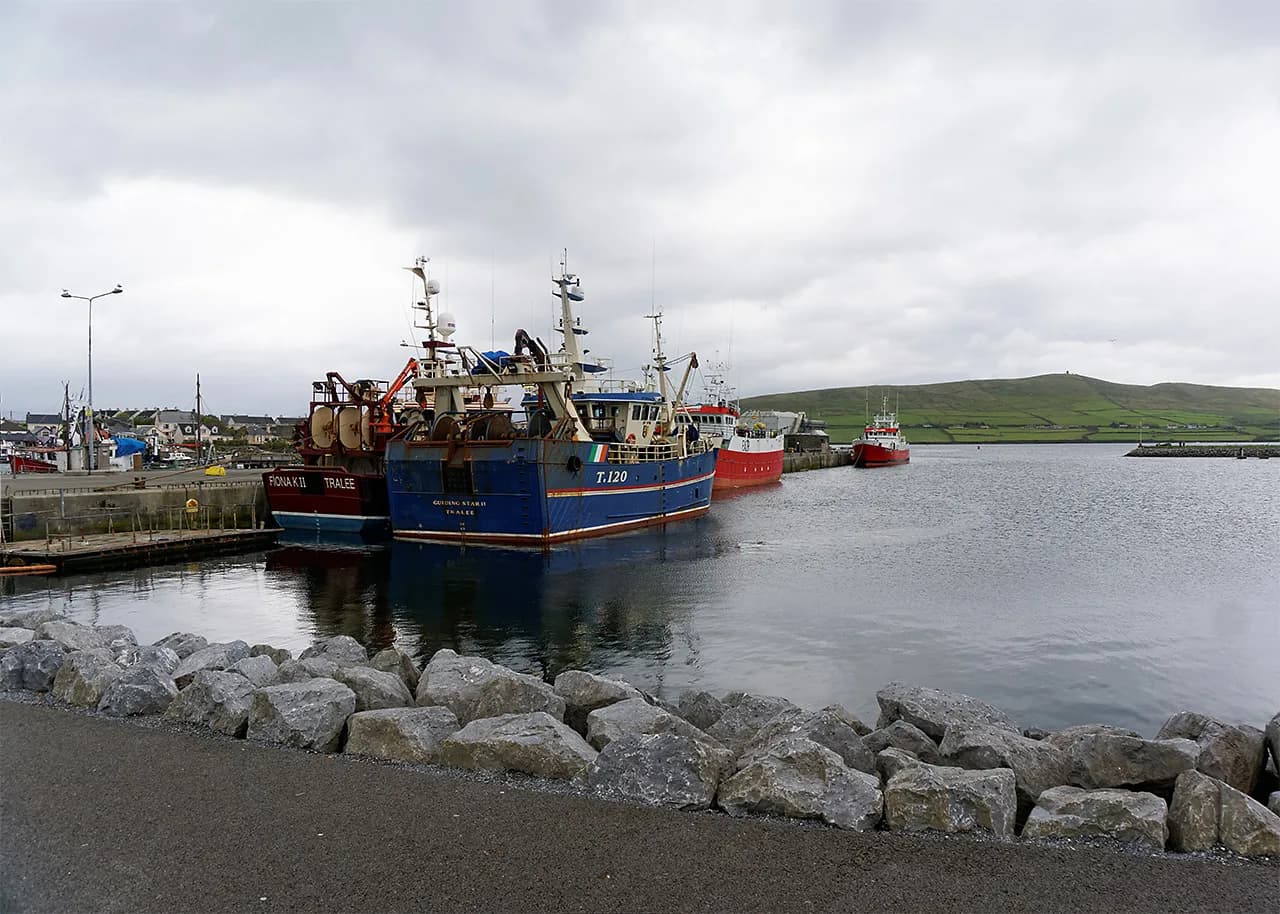
Dingle, or Daingean Uí Chúis, is the last proper town on the Dingle Peninsula before the Atlantic, a working harbour and a Gaeltacht of around 2,000 people that has become one of the most visited corners of the Irish southwest without losing its character. It is two things at once: a busy tourist town in high summer, where the coaches run the Slea Head road and the seafood restaurants fill, and a genuine Irish-speaking community with a deep musical tradition and a string of shop-pubs that have not changed in a century. Come for the drive around the peninsula's tip and the early-Christian sites along it, stay for the food and the pubs, and remember that the road signs being in Irish is not a theme: this is one of the strongest Gaeltachtaí left in the country.
History & Heritage
A Gaeltacht Town: An Daingean and the Naming Row
Dingle sits in the Corca Dhuibhne Gaeltacht, one of the Irish-speaking districts of west Kerry, and the language is a living one here rather than a relic. That is why visitors see road signs in Irish only as they cross into the Gaeltacht: An Daingean, or Daingean Uí Chúis, the older Irish name meaning the fortress of Ó Cúis. The names became a real controversy in the 2000s. A 2004 Placenames Order made An Daingean the sole official name and removed Dingle from the maps, which the town objected to, partly because the historic Irish name was always Daingean Uí Chúis and partly because An Daingean duplicated a town in Offaly. After a long campaign and a local plebiscite, a 2011 Act restored both: the official names are now Daingean Uí Chúis in Irish and Dingle in English. It is worth knowing the story rather than being puzzled by the signs.
Slea Head and the End of the Peninsula
The reason most people come is the Slea Head Drive, the loop of narrow road that runs west from the town around the tip of the peninsula. It is dense with sites: the cluster of beehive huts, or clocháin, on the farmland at Fahan, the crucifixion shrine and viewpoint at Slea Head with the Blasket Islands lying offshore, the strand at Coumeenoole, and Dunmore Head, the most westerly point of mainland Ireland, which doubled as the planet Ahch-To in the Star Wars films. The land is studded with early-Christian monuments too: Gallarus Oratory, the best-preserved dry-stone church in the country, and the medieval ruin at Kilmalkedar. North of the town, the Conor Pass climbs over the spine of the peninsula on one of the highest surfaced roads in Ireland.
The Shop-Pubs and the Music
Dingle has a famous concentration of pubs for a town its size, and the most distinctive are the surviving shop-pubs, where a bar shares its premises with a working shop. Dick Mack's on Green Street pours a pint on one side and sells leather and boots on the other; Foxy John's on Main Street is a hardware shop and bicycle workshop by day and a pub by night; Curran's keeps the old drapery shelves behind the bar. The music is the other constant: trad sessions run most nights of the week at An Droichead Beag, O'Flaherty's and John Benny's, among others, and in early December the town hosts Other Voices, an intimate music festival recorded in the tiny St James' Church and broadcast on RTÉ. The pubs are the social centre of the town, not a sideshow.
About the Dolphin
For nearly forty years Dingle's most famous resident was Fungie, a solitary wild bottlenose dolphin who lived in the harbour from 1983 and drew thousands of visitors onto boats to see him. He was last seen in October 2020 and is presumed dead; he was the oldest recorded solitary dolphin of his kind. The boat operators have moved on to genuine eco and wildlife tours out around the Blasket Islands, looking for seals, dolphins, seabirds and, in season, whales. You may still see Fungie's name on the odd old sign or listing, and a statue of him stands on the harbour, but he is gone, and any trip that promises to find him is selling something that no longer exists.
Wildlife & Nature
Marine Life
Bottlenose and common dolphins
Dolphins are regularly seen on the boat trips out around the Blasket Islands and along the open coast, along with harbour seals on the rocks. These are the wildlife the eco tours now centre on, since Fungie, the harbour's long-resident solitary dolphin, disappeared in 2020.
Spring to autumn, on the boat trips
Seabirds and basking sharks
The Blasket waters and the cliffs of the peninsula's end hold large seabird colonies, with gannets, guillemots and storm petrels, and in summer basking sharks pass along the coast. The Great Blasket also has a notable grey-seal colony.
Summer for basking sharks and breeding seabirds