The Mall, the 1798 Rebellion and the Races of Castlebar
A walk through the green heart of Castlebar and the day in 1798 when a French and Irish force sent the British army fleeing. Here is the history behind the monument on the Mall.
The green heart of the county town
If Castlebar has a centre of gravity, it is the Mall: a long, tree-lined green that runs through the middle of the town. It looks like a simple public park, and on a bright morning it is exactly that, with mature beech and lime trees, benches and a steady traffic of locals cutting through on foot. But the Mall has a longer story than most parks, and it carries one of the most dramatic chapters in the history of County Mayo.
The green was originally the cricket pitch of the Bingham family, the Earls of Lucan, who dominated Castlebar for centuries. It was the 4th Earl of Lucan who gave it to the people of the town in 1888, and it has been the town's main green space ever since. Stand in it today and you are standing on ground that the town has used, in one way or another, for well over two hundred years.
The French land at Killala
The Mall's place in history was sealed in the late summer of 1798. On 22 August that year, around 1,100 French troops under General Jean Joseph Amable Humbert landed in County Mayo to support the United Irishmen in their rising against British rule. They came ashore at Killala Bay in the north of the county, raised the rebel cause, and gathered Irish recruits as they moved south.
Their target was Castlebar, the county town and the seat of British power in Mayo. Waiting for them was a much larger British force, somewhere between 3,000 and 4,000 men, under General Gerard Lake. On paper it should have been no contest.
The Races of Castlebar
On 27 August 1798, Humbert's combined force of roughly 800 French soldiers and some 2,000 Irish rebels met Lake's army at Castlebar. The French had a trick up their sleeve. Local people had advised them of a route west of Lough Conn that the British thought impassable for an army hauling artillery. Humbert took it, and his force appeared from a direction the British had not anticipated. Lake had to redeploy his entire army in a hurry to face the threat.
What happened next gave the day its enduring nickname. The British militia broke and ran, and they ran fast. The speed of the retreat was so notorious that the engagement has been known ever since as the Races of Castlebar. The historian Thomas Pakenham, in his classic account The Year of Liberty, described it as one of the most ignominious defeats in British military history.
John Moore and the grave on the Mall
In the brief republic that followed the victory, a young local man named John Moore, brother of a Mayo landowner, was declared President of the Province of Connacht. The rising did not last. Humbert was forced to surrender after defeat at Ballinamuck in County Longford in September 1798, and the rebellion was put down. John Moore himself died not long after.
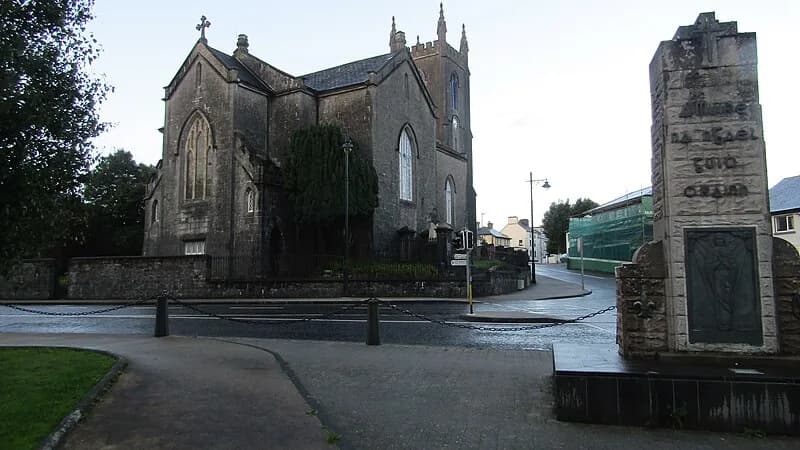
Today his remains lie in a corner of the Mall, marked by the 1798 monument that was raised on the 150th anniversary of the rising. It is a quiet, easy thing to miss if you do not know it is there, which is part of its charm. Stand by it and you are at the spot where the town chooses to remember the day it beat the empire, however briefly.
Walking the story today
The Mall is the natural starting point for a self-guided walk around the town's 1798 connections. From the monument and Moore's grave, it is a short stroll to the surrounding streets where the rebels and redcoats clashed, and on to the Linenhall, the handsome 1790 trading house that has watched over the town since before the rising. Set aside an hour or so and you can take the whole thing in on foot.
If you can time your visit for late August, the town marks the anniversary every year with the Castlebar 1798 Festival, a programme of music, historical lectures and commemorations. It is the best moment to feel how alive this history still is in Castlebar, a town that has never quite forgotten the day the British army went racing out of it.
Keep Reading
A Day at the National Museum of Country Life, Turlough
Ireland's only national museum outside Dublin sits in the grounds of Turlough Park, a few kilometres from Castlebar. Here is how to make a day of it, including the greenway and the round tower.
Food & DrinkWhere to Eat in Castlebar: A Local's Food Guide
From farm-to-fork sharing plates to a third-generation café and the town's best gastropub, here is where to eat well in Mayo's county town.
Planning a trip?
Explore restaurants, activities, accommodation, and more.