About Carrick-on-Shannon
The history, geography, and character of Carrick-on-Shannon.
History & Heritage
One town, two counties
The Shannon does not run past Carrick so much as through it, and the county boundary runs down the middle of the water. Everything you think of as the town, Main Street, Bridge Street, St George's Terrace, the Quay and the marina, is in Co. Leitrim, in the townland of Townparks and the civil parish of Kiltoghert. Cross the bridge and you are in Cortober, which is Co. Roscommon, in the parish of Killukin and the barony of Boyle. The railway station is over there. So is the cinema, and so is at least one of the bars the town drinks in. Locals treat the whole thing as one town and are faintly amused when visitors ask which county they are in. It matters for two practical reasons: satnav searches sometimes disagree with each other, and the things people assume are just outside town, Lough Key Forest Park and the Georgian town of Boyle, are in Co. Roscommon too, half an hour up the road rather than around the corner.
From ford to charter town
Carrick began as a crossing. The Battle of Áth an Chip was fought near here after the Norman invasion, and on old maps the place is Carrick Drumrusk, an anglicisation of the Irish name. A royal charter in 1607 made it a borough with its own seal, and the town marked four hundred years since its founding in 2013, which is when the current Carrick Carnival committee was formed. Three annual fairs were held here through the nineteenth and twentieth centuries, on 12 May, 11 August and around 21 November. The present council offices stand on the site of the old gaol, most of which came down in the 1960s, though a smaller eighteenth-century jailhouse still stands.
Why the quay is where it is
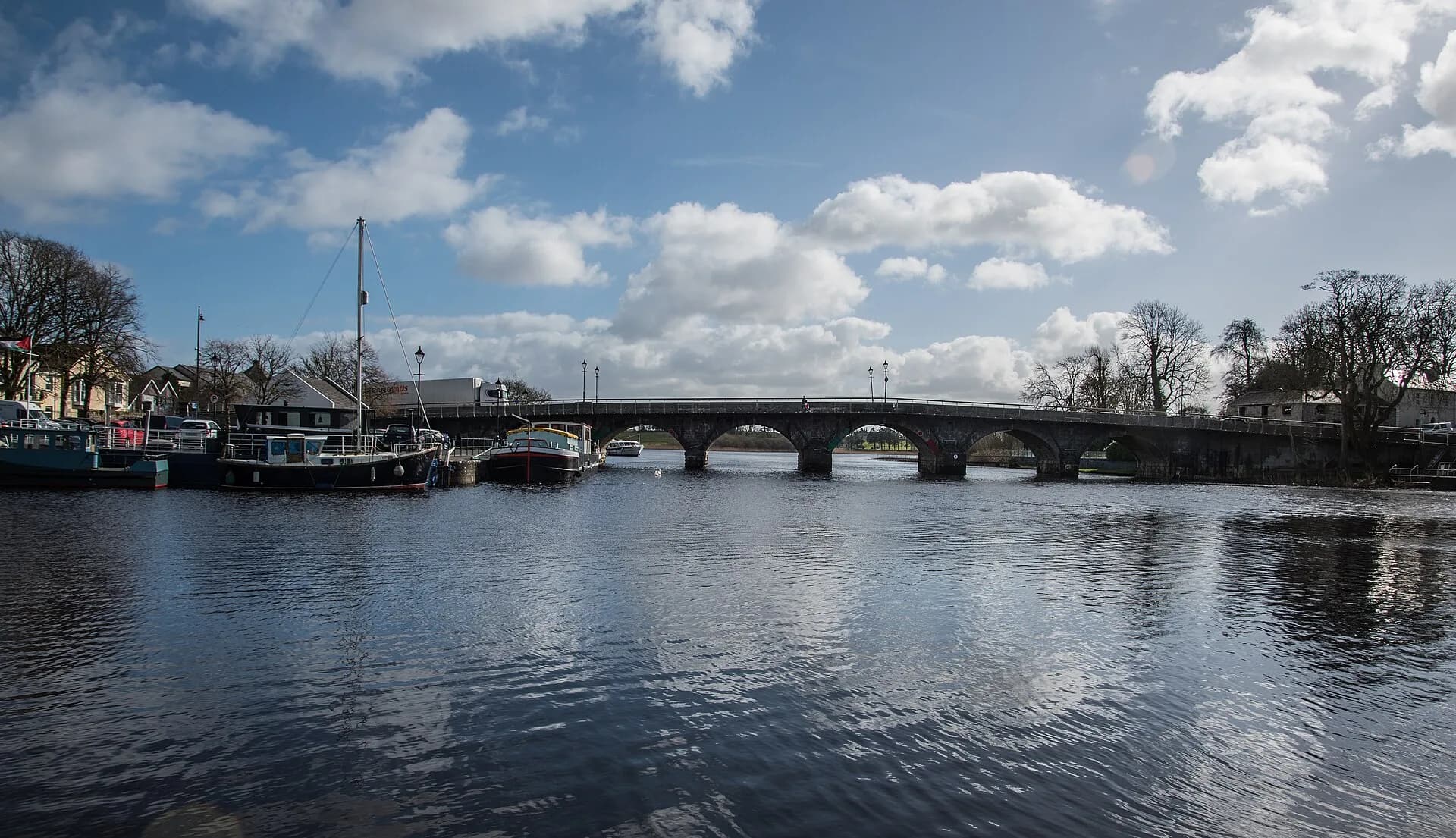
Until the early nineteenth century the head of the Shannon Navigation was at Drumsna, downriver. In the 1840s the river was dredged, the Jamestown Canal was cut, locks were built at Drumsna and Knockvicar, and Carrick got a new bridge and new quays. The bridge that stands today went up in 1846, replacing a nine-arch stone crossing which had itself replaced a wooden one. For more than a century after that, until the Grand Canal Company wound up in 1960, Carrick was a river depot: timber, cement, hardware and, above all, Guinness came upriver from Dublin, Athlone and Limerick. When the commercial traffic stopped, the infrastructure stayed, and the hire-cruiser trade grew into the space it left. That is the direct line between a Victorian freight quay and the two fleets of self-drive boats tied up there now.
The smallest room and the largest one
Two buildings carry most of the town's visitor traffic and they are almost comically mismatched. The Costello Memorial Chapel on Bridge Street is sixteen feet by twelve, built by Edward Costello for his wife Mary Josephine, dedicated in April 1879, with both of them in vaults under glass either side of the door. Two hundred metres away, The Dock occupies William Farrell's classical county courthouse, restored by Leitrim County Council and reopened in 2005 with three galleries, a performance space, artists' studios and the Leitrim Design House. A town of under five thousand people holding both a memorial chapel the size of a garden shed and a full working arts centre is a reasonable summary of what Carrick is like.
The workhouse and the Earl Grey girls
The heritage centre on Church Lane does not soften the Famine material. Between 1849 and 1852, more than four thousand Irish girls were sent from workhouses to Australia under the Earl Grey assisted emigration scheme, to work as servants in a colony short of women. Sixty of them left the Carrick-on-Shannon workhouse and forty left Mohill. Their names, and their parents' names, are on display in the reading room of the Workhouse Attic memorial. A line of bronze plaques is set into the footpath from the gate of the heritage centre, along the western side of Main Street and up to Summerhill, which was formerly Gallows Hill. A bronze sculpture of two of the girls leaving the workhouse was put up by the Carrick on Shannon Heritage Group in 2025.
A night out, and what that has done to the town
Carrick has a bar and restaurant count well beyond what a town of 4,743 people would normally support. The town's own tourism site sorts its nightlife into four separate headings, bars, late bars, sports bars and trad bars, which is not a distinction most Irish towns of this size need to make. Hen and stag parties have come here for years, drawn by the boats, the pub count and the fact that everything is inside a five-minute walk, and the town is open about it: the hotels and the cruiser operators all advertise for that trade alongside the riverside walks and the family stuff. What this means for a visitor is straightforward. Bridge Street and Main Street on a Saturday night are loud and busy in a way that will surprise you if you arrived expecting a quiet Leitrim market town. Sunday morning is the opposite. If you want the town at its calmest, come midweek, and Thursday market morning is the best of it.
Wildlife & Nature
Marine Life
Shannon coarse fish
The upper Shannon around Carrick is one of Ireland's long-standing coarse angling waters, holding bream, roach, rudd, hybrids, tench and pike. The locality has hosted national and international angling competitions. Most of the fishing is from the bank or from a hired dinghy rather than from the quay itself.
Late spring through autumn, with pike fishing better in the colder months
Birdlife
Mute swan
Resident on the river through the town, and a permanent feature of the water between the bridge and the marina. They are habituated to people and to boat traffic, which is a mixed blessing when a hire cruiser is turning.
Year round
Grey heron
Stands along the reedy margins upstream and downstream of the quay, most visible early in the morning before the boat traffic starts. The stretch of Blueway between Leitrim Village and Carrick is the best place to see them from the water.
Early morning, year round
Flora
Shannon reedbeds
The margins of the upper Shannon and its callows are reed and sedge, which is what gives the river its colour and the town its green-grey palette. The Blueway paddle trail runs through them between Leitrim Village and Carrick.
Summer, when the reeds are at full height