About Boyle
The history, geography, and character of Boyle.
Boyle is a market town of 2,915 people in the north of Co. Roscommon, on the Boyle river between Lough Gara and Lough Key, at the foot of the Curlew Mountains. It has more heritage per street than most towns its size, an abbey, a Georgian mansion and a demesne turned forest park, and for all that it is still a working town where people come in on a Saturday for the market and the shops.
History & Heritage
The abbey of the Boyle river
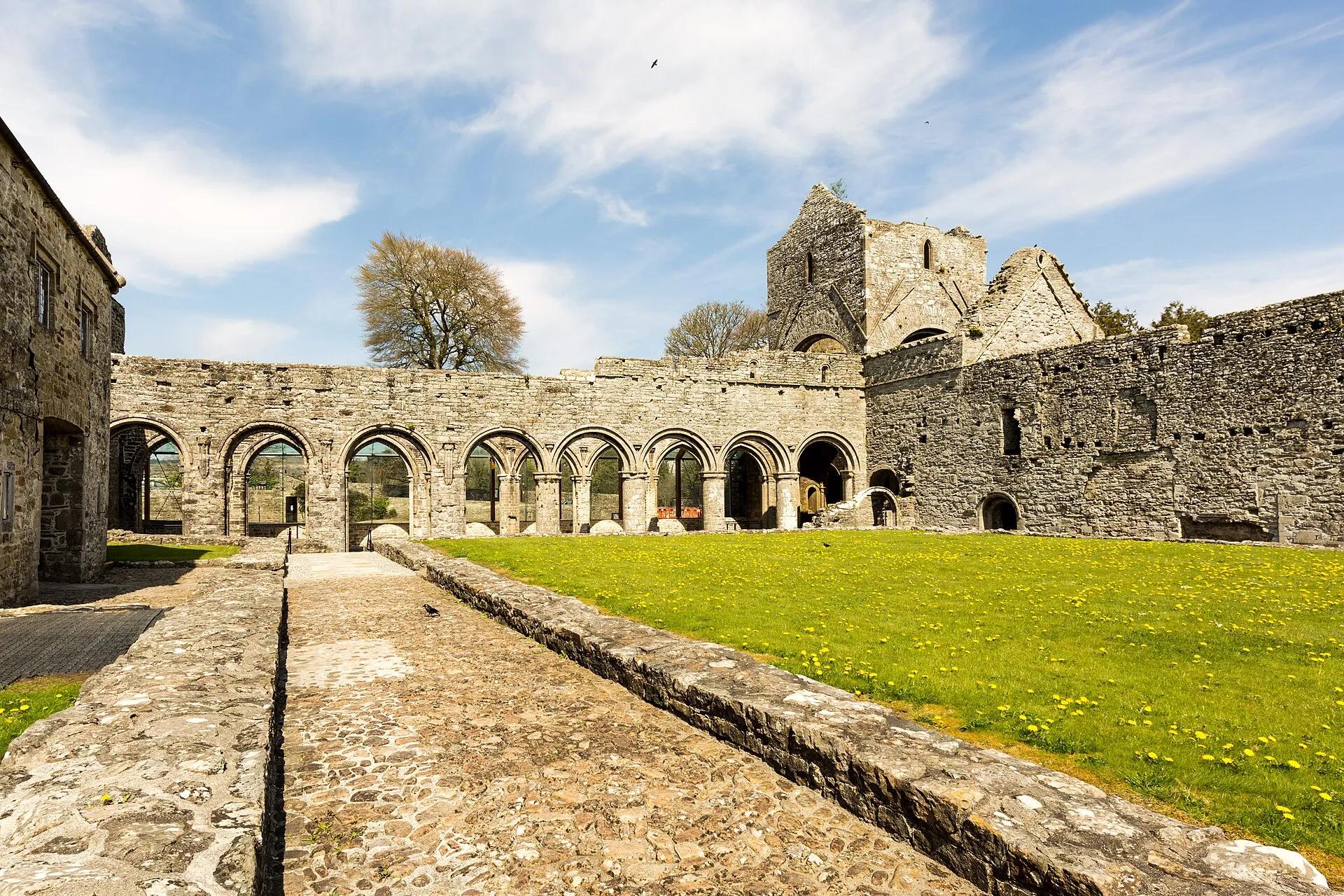
The Irish name, Mainistir na Búille, means the abbey of the Boyle river, and the abbey is where the town starts. Monks from Mellifont, the first Cistercian house in Ireland, founded it in the twelfth century under the patronage of the MacDermotts, who ruled Moylurg, the lordship that took in Lough Key and the land around it. It became one of the strongest Cistercian foundations in Connacht. Its later history is mostly damage: Cromwellian forces occupied it in 1659, and it then spent long years housing a military garrison. What survives, the nave arcade, the crossing tower and a remarkable set of carved capitals, is in the care of the OPW and open in season. Just downstream, Abbeytown Bridge, a five-arched stone bridge over the river, is described by the county council as dating from the late twelfth century and one of the oldest surviving stone bridges in Ireland.
The Kings, and a big house in the middle of town
After the Cromwellian settlement, the MacDermott lands passed to the King family, who would be resident landlords in Boyle for some 350 years. In the early eighteenth century they built King House on what is now Military Road, and the unusual thing about it is where it is: an Irish big house in the middle of a town rather than at the end of a long avenue. When the family moved out to their new mansion at Rockingham, the house became a barracks and, through the nineteenth century, the depot of the Connaught Rangers. After independence it was an Irish Army barracks, and later a merchant's store, before Roscommon County Council bought it in 1987 and restored it. It reopened as a museum in the 1990s and marked thirty years as a visitor attraction in 2025.
Rockingham, and what is left of it
Rockingham was the Kings' estate on the southern shore of Lough Key, laid out by the landscaper John Sutherland, with a house designed by John Nash, the architect of Regent Street, in 1809 and 1810. Nash is also credited with the gate lodge on the N4 and the Fairy Bridge in the woods. The house burned in 1957, the state took over the land, the shell was demolished in 1971, and in 1973 the concrete Moylurg Tower went up on the site. What remains is the landscape: the Great Lawn on three sides of the old house, the servant tunnels, follies and bridges, and the view out to Castle Island, where the MacDermotts had their stronghold and the Kings later built a folly. It is now Lough Key Forest and Activity Park, run by a joint venture between the county council and Coillte.
The Curlews and 1599
The Curlew Mountains rise just north of the town. On 15 August 1599, during the Nine Years' War, an English force under Sir Conyers Clifford marching through the pass was ambushed and routed by an Irish army under Red Hugh O'Donnell, one of the heaviest defeats the English suffered in Ireland in that war.
The Royal, and a town turning back to its river
For 230 years the Royal on Bridge Street was the town's hotel. It was built in 1782 as a coaching inn on the Dublin to Sligo road, Yeats and Maud Gonne stayed there, and so did Maureen O'Sullivan, and it closed in 2012. Boyle has had no hotel since, which is a long-running local complaint and the reason the town's beds are B&Bs, guesthouses and self-catering. The council bought the derelict building in 2017 and in 2023 reopened it as An Ríoga, an enterprise and cultural centre with a gallery on the ground floor, as the first step of a regeneration plan the town calls Boyle 2040. The idea, in the words of the town team at the opening, is a town turning towards its river rather than having its back to it, with a riverside walk linking An Ríoga, King House and the abbey.
Two film careers and a sitcom
Boyle has produced two very different film careers. Maureen O'Sullivan, born yards from King House where her father was an adjutant in the Connaught Rangers, went to Hollywood and starred in some seventy films, most famously as Jane opposite Johnny Weissmuller's Tarzan; King House has an exhibition on her. Chris O'Dowd grew up in the town and set his sitcom Moone Boy here, and Lough Key's own filming page lists scenes shot in the park. The craft shop in the King House grounds sells the hand-knitted Moone Boy hat.
Wildlife & Nature
Flora
Bluebells and wild garlic
The broadleaf and conifer woods of the old Rockingham estate carry wild bluebells and wild garlic in spring, and you smell the garlic before you see it on the woodland paths around Lough Key and along the cycleway from Boyle.
April and May