A wet day in Dunfanaghy: the Workhouse, the Heritage Trail and Doe Castle
What to do in Dunfanaghy when it rains: the 1845 workhouse and Wee Hannah Herrity's story, the ten-stop audio trail through the village, the Stewarts of Horn Head, and the MacSweeney castle across the bay.
Dunfanaghy is a beach-and-headland village, and on a wet day it can look as if there is nothing else. There is. The village has a workhouse, a market house, three churches and a landlord's big house, each with a story, and across the bay there is a MacSweeney castle you can walk round for free.
The Workhouse
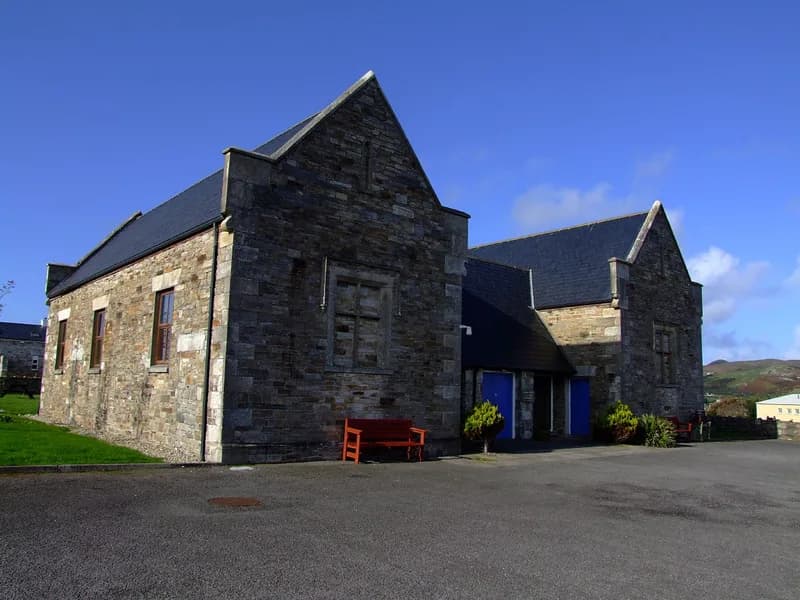
The grey stone building on the western edge of the village opened on 24 June 1845, the year the potato crop first failed. It was one of eight workhouses in Co. Donegal, for a Poor Law Union whose area included Dunfanaghy, Creeslough, Derryreel, Falcarragh and Derryveagh. Only five people were admitted at first. By 1847 it had been extended, and by 1851 it held 481 people. The Workhouse's own history notes that the Board of Guardians insisted on stone flag floors rather than earthen ones, and that the building was paid for by a loan later repaid out of the local rates.
It closed in 1918, was used afterwards as a co-operative and a store, was declared a heritage site in 1989 and reopened in 1995 as a Famine heritage centre, 150 years after it first opened. The exhibition is a self-guided audio tour through the original rooms, and its centre is Wee Hannah Herrity, a local woman who survived those years and later told her story in her own words. It ends with a short film of the Dunfanaghy area from the 1930s to the 1960s. Allow an hour to an hour and a half.
The practical points: the Workhouse is open daily from 10:00 to 17:00 from February to November, and closed in December and January except for pre-arranged groups. The exhibition and the small café close at 16:00. The audio is in English, with printed transcripts in Irish, French, Italian, German and Spanish. The ground floor and part of the exhibition are accessible, with a lift to the upper section. The exhibition is not suitable for very young children, but the playpark is next door, and staff will split a family so one adult can go round while the other minds the small ones. OPW Heritage Cards are not accepted.
The Heritage Trail
The Dunfanaghy Heritage Trail, launched in October 2021 by Dunfanaghy Tidy Towns with Donegal County Council, starts at the Workhouse and runs back east through the village in ten stops: Holy Cross Church, Pound Street, Main Street, Arnolds Hotel, the Presbyterian church, the Green, Market Square and the pier, the old Garda station and the Robertson Board School, and Holy Trinity Church of Ireland. Each stop has a three-to-five-minute audio story on a free app, in English or Irish. It takes about an hour and works in light rain with a hood up. Groups of eight or more can book a guide through the Workhouse at €10 a head.
The Stewarts and Hornhead House
On the way onto Horn Head you pass an old house in the trees, known locally as the Big House. This was Hornhead House, home of the Stewarts, the local landlords, who bought the Horn Head estate in 1700 and stayed until 1922. The Workhouse's local-history blog has the best version of the story, and the most surprising part of it is about the land rather than the family. During the First World War, it says, the marram grass on the dunes was cut and sent to France as bedding for army horses. With nothing to hold them, the dunes blew in the storm of 1917, silted the sand bar and blocked the bridge, and the lake that formed behind it is still called the New Lake, An Loch Úr. Stewart family memorials are in Holy Trinity Church, the last stop of the Heritage Trail.
Doe Castle
If the rain lifts, drive round Sheephaven Bay to Doe Castle, about fourteen kilometres away off the R245 between Creeslough and Carrigart. It was the stronghold of the MacSweeneys, built in the 1420s according to the Office of Public Works. At least thirteen MacSweeney chiefs held it; one sheltered survivors of the Spanish Armada in 1588, and the last marched out with Red Hugh O'Donnell to the Battle of Kinsale in 1601. Inside the tower is a carved MacSweeney grave slab of 1544.
The grounds are open every day, all year, and free. The keep is a different matter: tours inside are by appointment only, booked by email through the address on the OPW's Doe Castle page, so if you just turn up, it is the walls, the water and the display panels. Ards Forest Park is on the way back, and Coillte's car park there stays open until 17:00 in the winter months.
And then lunch
For lunch on a wet day, the café above the pottery at Muck 'n' Muffins on the Square is the obvious choice, and the pots on the ground floor are made in the building. In the evening, Arnolds Hotel's Whiskey Fly Bar has open fires and the hotel's full dinner menu when the main restaurant is closed for the season.
Keep Reading
Horn Head: the drive, the walk to the signal tower, and when not to go
How to get onto Horn Head from Dunfanaghy, what the road is like, the walk from the coastguard station to the signal tower, and the weather and cliff-edge rules that matter more than anything else.
ActivitiesKillahoey, Marble Hill and Tramore Beach, Horn Head: which Dunfanaghy strand for what
The three big beaches around Dunfanaghy are very different places. Which ones have lifeguards, which is the surf school's beach, which one you have to walk to, and where else to get in the water.
Planning a trip?
Explore restaurants, activities, accommodation, and more.